


In this article we will enjoy Stoltz’ best-known game, also featured – as the author Steve Giddins mentioned in a YouTube comment – in New in Chess’ “The Most Exciting Games of Chess Ever Played” (slight digression, I did a short video series of 4 games for that book). It was former World Champion Ruslan Ponomariov’s selection for the book.
The game created a huge stir at the time, as Stoltz sacrificed first his queen and then offered a further rook. Even to jaded modern eyes it’s still a feast of tactics and ingenuity!
Spielmann,Rudolf – Stoltz,Gosta [C06]
Match Stoltz-Spielmann +2–1=3 Stockholm (5), 17.11.1930
[[EB] E.Böök, Stormästaren Gösta Stoltz bästa partier. Game 13
[TfS] https://tfsarkiv.schack.se/pdf/1930/tfs_1930_12.pdf, annotations by R.Spielmann]
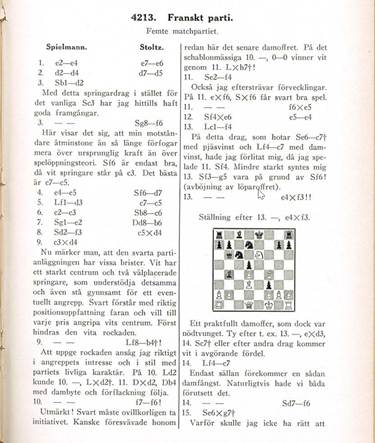
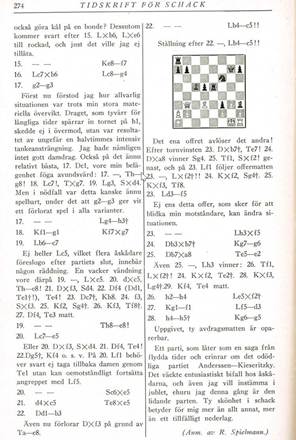
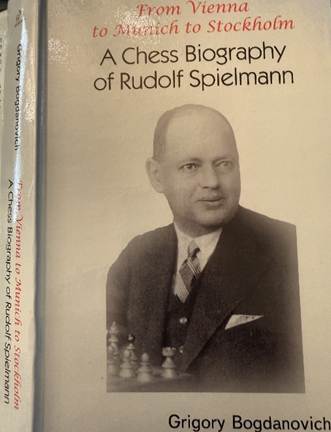
[GB] A Chess Biography of Rudolf Spielmann by Grigory Bogdanovich (Elk and Ruby). Also cites comments by Spielmann
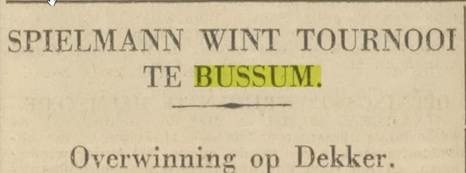
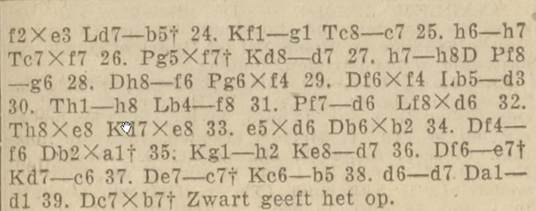
Although no comments are cited in the text, I also found the game Spielmann-Dekker Bussum 1934 (after 10…0-0) in “De courant – Het nieuws van den dag” from 15th May 1934 reportimg on Spielmann’s victory there (found on delpher.nl)
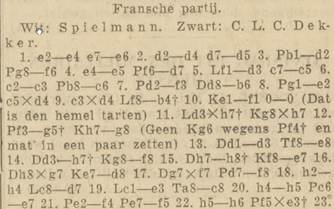
1.e4 e6
[EB] “According to Stoltz this was the first time he played the French” He only played it 3 times in total during his career.
2.d4 d5 3.Nd2 Nf6
[EB] “Stoltz chooses a defence that has often been regarded as disproved yet has nonetheless proved to be quite viable”
[TfS] 3…c5 is better
The judgement of modern theory hasn’t changed much in nearly 100 years! 3…c5 is generally seen as the stable choice – it was recommended both by Anish Giri in his Chessable Lifetime Repertoire course and by Vassilios Kotronias in his “Win with the French!” – while 3…Nf6 is somewhat creakier. Its most faithful adherent in past years has been the English grandmaster Simon Williams.
Tarrasch himself gave 3…Nf6 a “?” in his “Three Hundred Chess Games”!
4.e5 Nfd7 5.Bd3 c5 6.c3 Nc6 7.Ne2
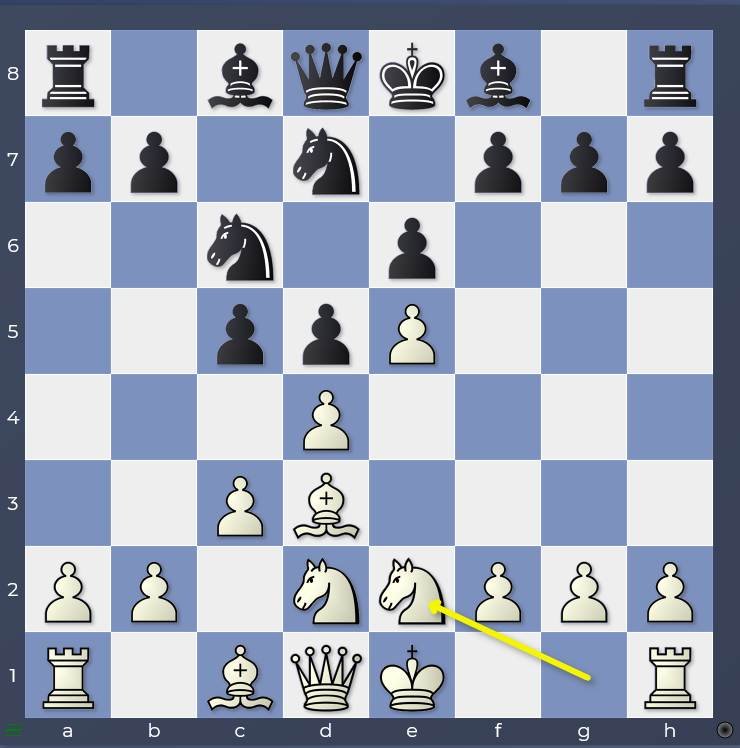
[EB] “This was first played by Dr Tarrasch in practice games against Eckart. The square f3 is left open for the queen’s knight.”
It’s a pretty impressive development scheme for Tarrasch to have devised from scratch: White’s knights are placed harmoniously to protect the weakest point of White’s centre without interfering with the development of the light-squared bishop. And as we shall see in many variations, the knights are ready to spring into action against the black kingside (missing the cover of the king’s knight) with Nf4 and Ng5
7…Qb6 8.Nf3 cxd4
The practice games [EB] was referring to are not in the databases but you can find them in “Three Hundred Chess Games” by Siegbert Tarrasch: 8…Be7 9.0–0 0–0 10.Nf4 Nd8 11.Qc2 f5 12.exf6 Nxf6 13.Ng5 g6 14.Bxg6 hxg6 15.Qxg6+ Kh8 16.Qh6+ Kg8 17.Ng6 1-0 Tarrasch-Eckart Nuremberg 1889/1890.
9.cxd4
TfS “You can see that the black position has some shortcomings. White has a strong centre and two well-placed knights to support it and also help launch an attack. Black understands the danger correctly and desires to attack the white centre at all costs”
9…Bb4+
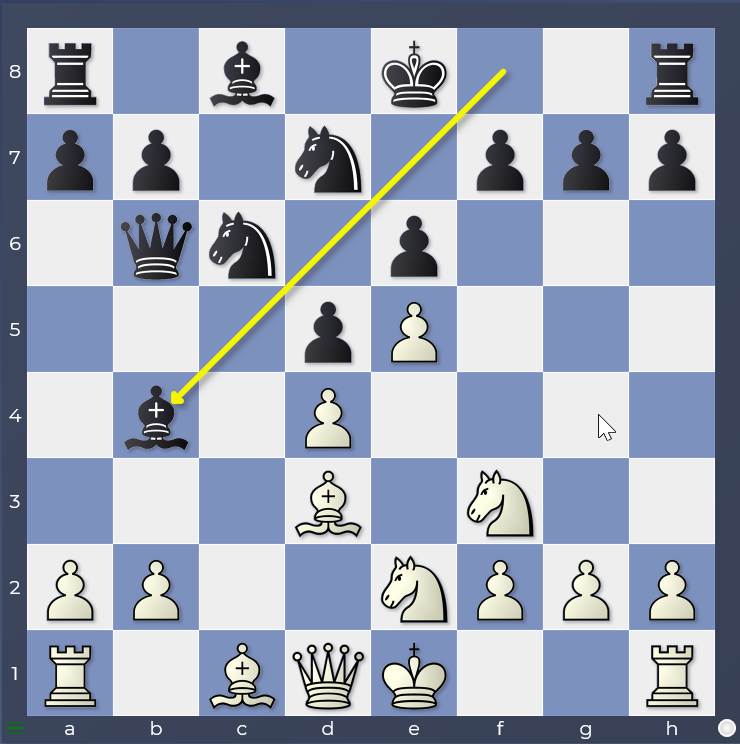
This was the most popular choice in the early 1930s at the time though both 9…Qb4+(?!! by Duras!) and 9…f6 had been tried in single games before this one. This is only the second game with 9…Bb4 in the database!
[EB] “The modern theory now continues with 9…f6 10.exf6 (10.Nf4 fxe5 11.Nxe6 is again much less effective for White than the game after 11…e4) 10…Nxf6 There is still some debate as to whether Black can equalise or not” 11.0–0 Bd6 has nearly 4700 games in the database and scores about 57% for White.
10.Kf1
[EB] “A very sharp move which according to recent practice appears to be correct. The text was also used by Alekhine in the game against Capablanca in the 1938 AVRO tournament as the Cuban did not dare enter the following lines”
“Keres played the unassuming 10.Bd2 [This had also been played in a game (successfully) prior to Stoltz’ game and it is the engine’s top move] 10…Bxd2+ 11.Qxd2 Qb4 12.Rc1 Qxd2+ 13.Kxd2 and achieved a better endgame which he won thanks to precise play” I guess that Alekhine had had enough of …Qb4+ queen exchanges from Capablanca during the 1927 World Championship match!
10…f6
The best and critical move according to the engines.
a) 10…Be7 was Capablanca’s choice. After 11.a3 however (11.h4 f6 12.Nf4 fxe5 13.dxe5 Ndxe5 14.Nxe5 Nxe5 15.Qh5+ Nf7 16.Bxh7 Qd4 17.Be3 Qe5 18.Qg6 Qf6 19.Re1 is the engine main line with a slight advantage for White.) Capablanca could (and should) have played 11…f6 when 12.Nf4 fxe5 13.Nxe6 is much less effective than in the game against 13…e4 You’ll understand why that is when we dive into the game continuation.
b) 10…0–0 is countered by 11.Bxh7+ with the terse comment in [TfS] “White wins”
Spielmann had the chance to prove this assertion 4 years later in a game not present in the databases but included in his “Art of the Sacrifice” from which Grigory Bogdanovich cites extensively in Chapter IX of [GB]
John Nunn considered this sacrifice unnecessary, believing that 11.Nf4 gave equivalent chances without the need to exert oneself in calculation and he even formulated a principle DAUT – Don’t Analyse Unnecessary Tactics – to encapsulate this! 11.Nf4 is indeed also very strong (the engine evaluation is above +2) but in terms of playing the best move on the board, 11.Bxh7+ is definitely it (above +3))
11…Kxh7 12.Ng5+ Kg8 (12…Kg6 [GB] 13.Qd3+ f5 14.Nf4+ Kxg5 15.Qg3+ Kh6 16.Qg6#) 13.Qd3 Re8 14.Qh7+ Kf8
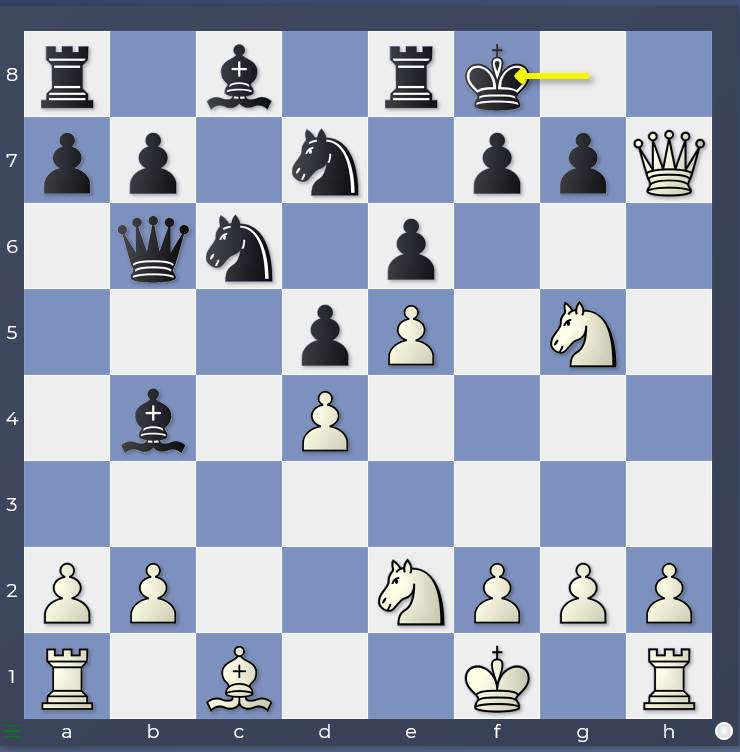
and now the astonishing engine idea is 15.Nf3 which is over +4! White’s threat is to play Qh8+ and Bg5+ and pick up the black kingside whole causing maximum damage at the same time! The lines are not universally obvious but all very painful for Black! (15.Qh8+ Ke7 16.Qxg7 Kd8 17.Qxf7 Nf8 18.h4 Bd7 19.Be3 Rc8 20.h5 Ne7 21.Nf4 Nf5 22.h6 Nxe3+ 23.fxe3 Bb5+ 24.Kg1 Rc7 25.h7 Rxf7 26.Nxf7+ Kd7 27.h8Q Ng6 28.Qf6 Nxf4 29.Qxf4 Bd3 30.Rh8 Bf8 31.Nd6 Bxd6 32.Rxe8 Kxe8 33.exd6 Qxb2 34.Qf6 Qxa1+ 35.Kh2 Kd7 36.Qe7+ Kc6 37.Qc7+ Kb5 38.d7 Qd1 39.Qxb7+ 1–0 Spielmann-Dekker, Bussum 1934) 15…f6 16.h4 Kf7 17.exf6 Nxf6 18.Ng5+ Kf8 19.Qh8+ Ng8 20.Rh3 Nxd4 21.Be3 e5 22.Bxd4 and Rf3 is coming in next! The main line is 22…Qh6 23.Rf3+ Ke7 24.Bxe5 Qxh8 25.Rf7+ Kd8 26.Bc7+mate!
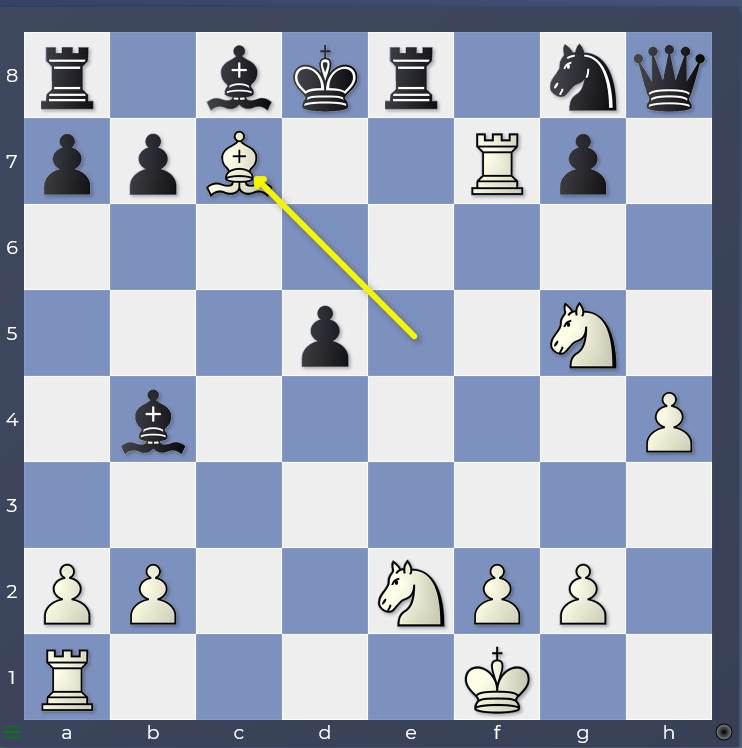
Brilliant!
11.Nf4
11.exf6 Nxf6 [TfS] “gives Black a good position”
11…fxe5
11…Ndxe5 is an interesting suggestion of [GB] which has only been played 6 times. The Monte Carlo Chessbase functionality played about 7000 lightning-fast games from this position with a 52% score for White which suggests it’s a pretty decent idea for Black.
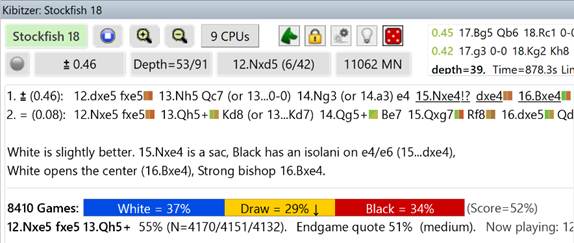
12.dxe5 (12.Nxe5 fxe5 13.Qh5+ is also interesting for White but Black survives after 13…Kd8 14.Qg5+ Be7 15.Qxg7 Rf8 16.dxe5 Qd4 followed by …Qxe5.) 12…fxe5 Black regains the piece after 13.Nh5 0–0 14.Be3 Qc7 15.Ng3 e4 16.Nxe4 dxe4 17.Bxe4 but White remains with a slight advantage after organising his kingside with g3 and Kg2
12.Nxe6
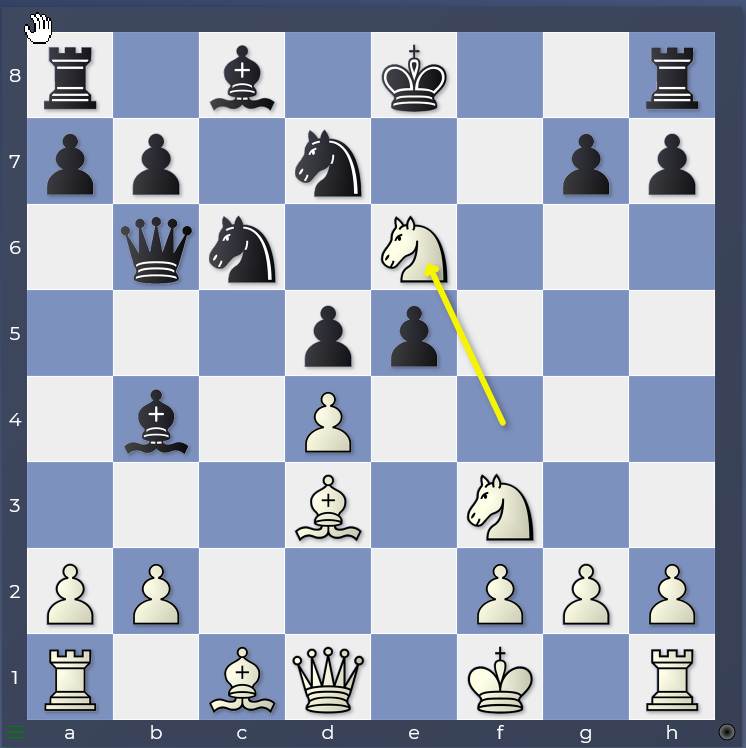
12…e4
Undoubtedly the move you should look at first as Black! The g7–pawn is left hanging but Black hopes to gain material with the fork.
a) 12…Nf6 “!? In a Moscow 1962 game Vassiltjuk-Tjinarev White secured a decisive advantage after13.Nxg7+ Kf8 (13…Kf7 14.Nh5 is the key tactical point! 14…Nxh5 15.Ng5+ Ke7 16.Qxh5 Qxd4 17.Be2 Be6 18.Qh6 Bf7 19.Nxf7 Kxf7 20.Bg5 Ke8 21.Qe6+ Ne7 22.Bb5+1–0 Levin,N-Lutikov,A URS Trade UnionTeam-ch Ivanovo 1951) 14.Bh6 Kg8 15.Qc1 [This is also the engine recommendation and looks very scary for Black with Qg5 on the way]. 15…Ng4 16.Nh5 (16.Nf5 “is even stronger”) 16…Be7 17.h3 Nb4 18.hxg4 Nxd3 19.Qd2;
b) 12…g6
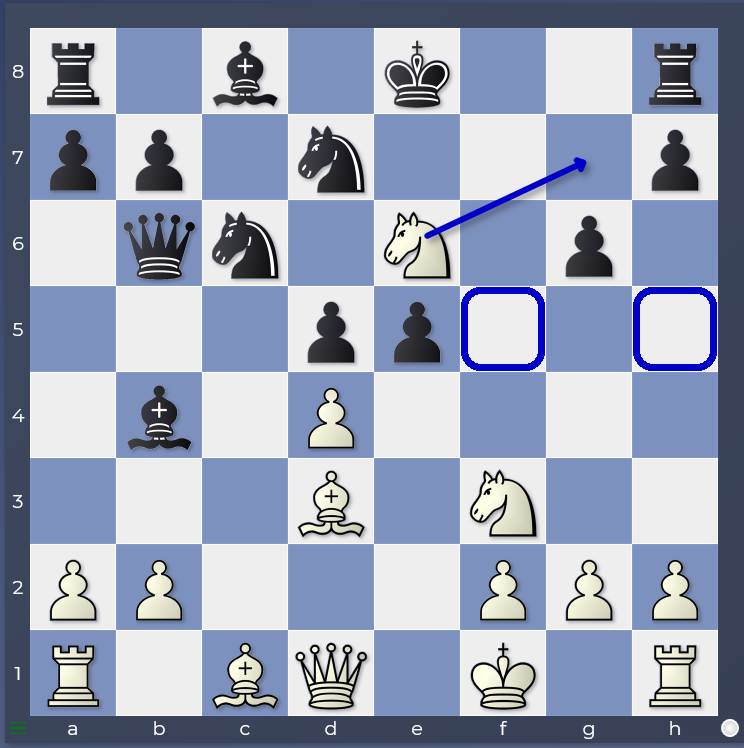
however is the engine best move! It was played only once – quite recently in 2011/12 – and keeps Black afloat. If he knows his stuff, the position after best play is not too bad for a black player!
a) 13.Nfg5 was played in the only game so far and it’s also strong. However after the best 13…Be7 14.Ng7+ was a poor follow up (14.h4 Nxd4 15.Nxd4 Qxd4 16.Be3 Qxb2 17.Ne6 is a dangerous double pawn sacrifice although Black seems to hold after 17…d4 18.Nc7+ Kd8 19.Ne6+ Ke8 20.Nxd4 Nf6 (20…exd4 21.Bxd4 Qxd4 22.Bxg6+ hxg6 23.Qxd4) 21.h5 Bg4) 14…Kf8 15.N7e6+ Kg8 16.dxe5 Ndxe5 17.Be2 Strangely enough this is the line recommended by DecodeChess which just goes to show that low depths can be tricky in complicated positions! 17…Nb4 18.Be3 Qd6 19.Bc5 Qd7 20.Rc1 Bxc5 21.Nxc5 Qd8 22.h4 b6 23.Nd3 Nbxd3 24.Bxd3 Bb7 25.Rh3 Qd6 26.Re3 h6 27.Nf3 Ng4 28.Re1 Rf8 29.Qe2 Rf7 30.Qe6 Nh2+ 31.Nxh2 Qxh2 32.Qxg6+ Kf8 33.Bb5 Qh1+ 34.Ke2 Qxh4 35.Kd3 Qg5 36.Re8#1–0 Crouch,C (2374)-Twyble,M (2274) BCF-chT2a 1112 (4NCL) England 2011 (4.1)
b) 13.dxe5 is the engine main line when 13…Ndxe5 14.Be3 Qa5 15.a3 Bxe6 16.axb4 Qxb4 17.Nxe5 Nxe5 18.Ra4 Qd6 19.h4 Nxd3 20.Qxd3 Bf5 21.Qd4 0–0 22.h5 Qf6 23.Qxd5+ Qf7 24.Qd2 (24.Qxf7+ Rxf7) 24…Rfd8 25.Rd4 Qf6 is just about alright for Black.
13.Bf4
At first sight this looks dangerous but messy – Black will take a piece, White will grab a rook on a8 with Nc7+ and Nxa8 and the game will be completely irrational with White’s extra material stuck on a8 and the white king on f1 blocking in the rook on h1. However, the threat is somewhat different!
[TfS] “I had relied on this move which threatens both Nc7+ winning a rook and Bc7 trapping the queen”
13.Nfg5 Nf6 [TfS]
13…exf3
[EB] “The only way to fish in murky waters”
[TfS] “A magnificent sacrifice which was however necessary”
13…Ba5 is the engine top move, freeing some space for the queen and adding some cover to c7 but it’s also pretty grim after 14.b4 (cleverly blocking the b4-square or exposing the black queen to further attack) Nxb4 (14…Qxb4 15.Nxg7+ Kf7 16.Rb1) 15.Nc7+ Qxc7 16.Bxc7 Bxc7 17.Bb5 exf3 18.Qe1+ is the evil twist at the end!
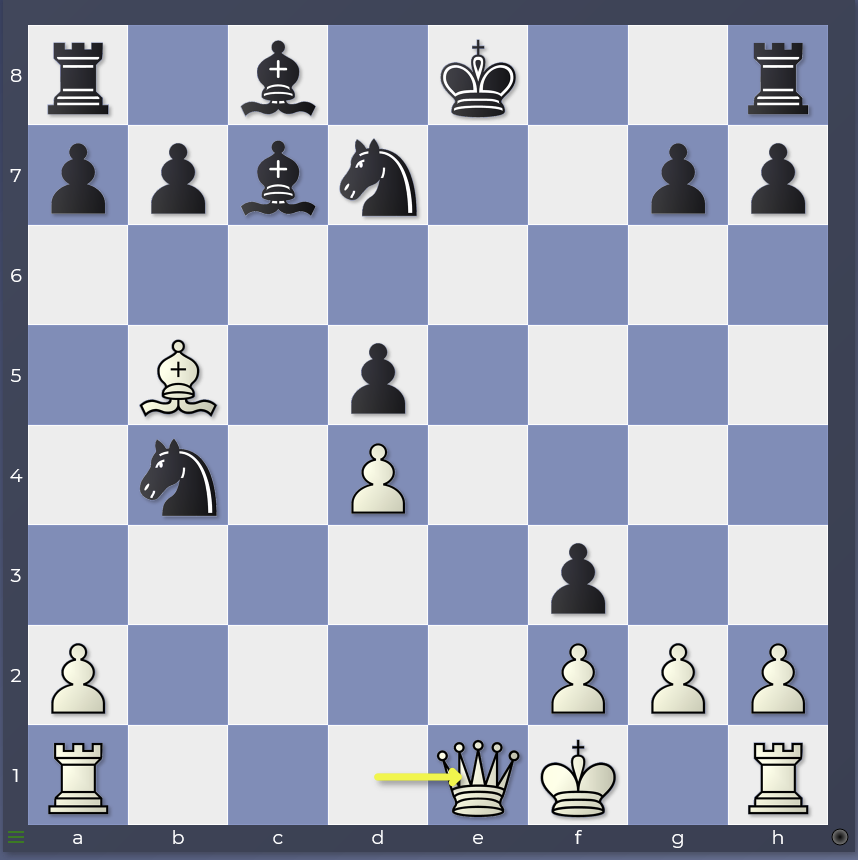
13…exd3 14.Nc7+ [TfS] “White has a decisive advantage” 14…Kf7 15.Nxa8 Qd8 16.a3 Be7 17.Nc7 Nb6 18.Qxd3
14.Bc7
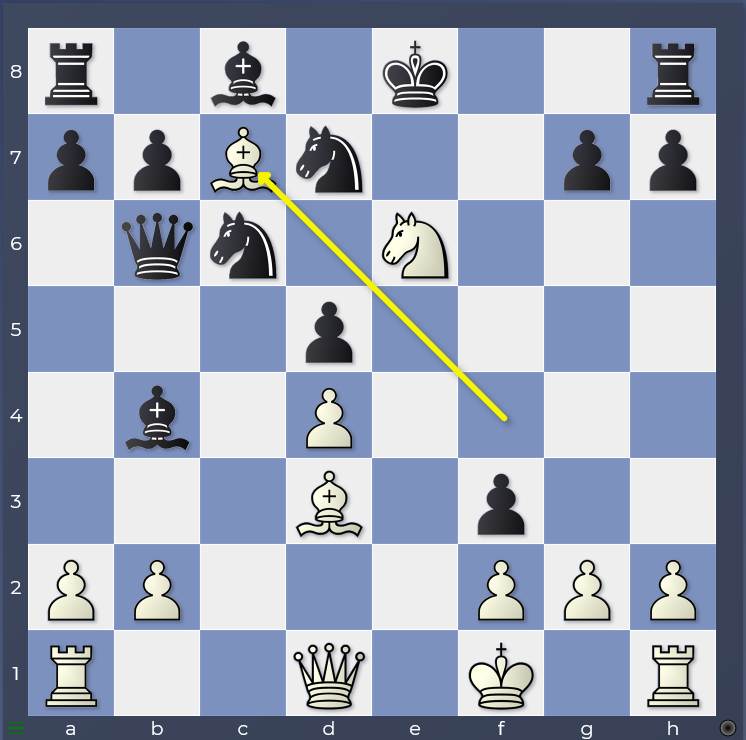
The queen is trapped! I think you understand now why all these lines without the bishop on b4 (either 9…f6 immediately or 11…f6 after Capablanca’s 10…Be7) are much better versions for Black. Without the bishop on b4, the black queen has escape squares on b4 or b2 (capturing the white pawn) Here however, the black queen is trapped! Stoltz goes for confusion!
14…Nf6 15.Nxg7+
[EB] “Spielmann rejected 15.Bxb6 Bxe6 because he felt it left Black too solid. [I think that’s what was said – my AI translation was not too clear!] 16.Bc5 [This would have been my preferred idea – it was the line that popped into my head right away. Rather than give Black the g-file to possibly do something with, use a tempo to get the bishop into an exchanging post (16.a3 Bd6 17.Bc5 is an engine suggestion which also looks very strong) 16…Bg4 17.Qb3 White would have won easily. The game continuation should also win”
15…Kf7 16.Bxb6 Bg4
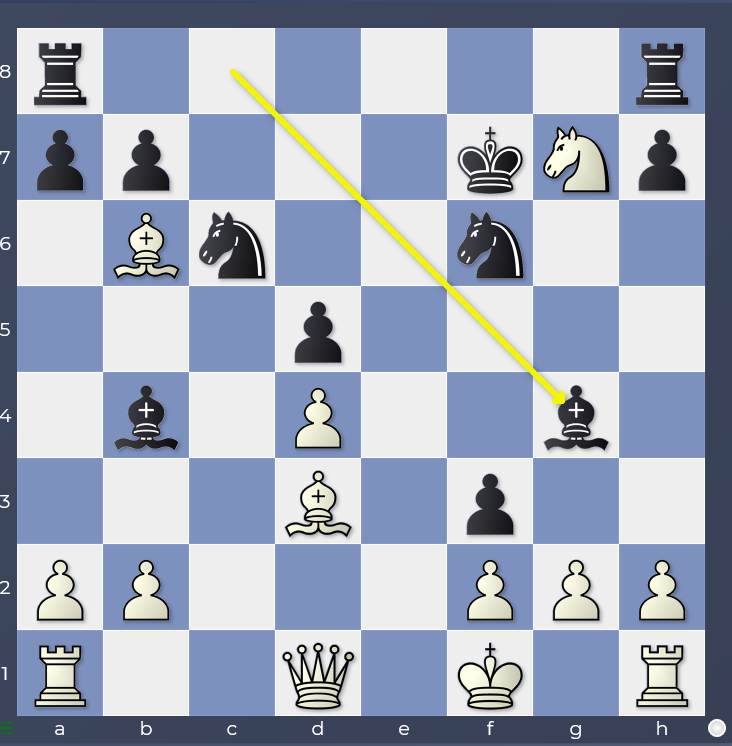
Black is a queen down for just a piece!
17.g3
[EB] “Here White goes along with the unfortunate idea that he can capture the pawn on f3 and thereby break the blockade on White’s kingside. This turns out to be a miscalculation.”
[TfS] “17.g3 gives White a losing game in all its forms” (!)
As Spielmann’s comments – written I imagine just after the match had concluded – show, he became quite pessimistic as the game progressed. I suspect that it came as a result of his long think on his 17th move (more than 30 minutes) during which he devised the plan of playing 17.g3 and allowing his king and rook to be temporarily pinned down by the bishop on h3, assuming he could clean up the f3-pawn and then evict the bishop. However, thanks to some miraculous tactics (which Spielmann spotted during the game) winning the f3-pawn proved extremely fraught. And I think his emotional reaction to Black’s unexpected resources prevented him from finding other ways of nullifying Black’s activity.
a) 17.Qb3 [EB] “Spielmann himself later recommended this simple positional continuation” 17…Kxg7 (17…axb6 18.Nf5; 17…Rag8 is the engine move when 18.h3 fxg2+ 19.Kxg2 Bd7 20.Bc5 or 20.Bc7 is very strong for White) 18.Bc5;
b) 17.Qc1 is another engine suggestion and is Spielmann’s suggestion in [TfS] 17…Rhg8 (17…fxg2+ 18.Kxg2 Rhg8 19.h3 Bd7 20.Bc7 Rxg7+ 21.Kf1 is the engine best line with a 4.81 evaluation!) 18.Bc7 Rxg7 19.Bg3 Nxd4 is Spielmann’s line which is not far off optimal! But whereas Spielmann seems very pessimistic about his chances, the engine assesses the position as +3 for White!;
c) Even 17.gxf3 Bh3+ 18.Kg1 Rag8 (18…axb6 19.Bf5 [GB]) 19.Bc7 Rxg7+ 20.Bg3 h5 21.Bf1 Bd7 22.h4 is winning for White
17…Bh3+ 18.Kg1 Kxg7 19.Bc7
19.Bc5 Bxc5 20.dxc5 Rhe8
a) 21.Qxf3 This is the first example where White could try and grab the f3-pawn 21…Nd4
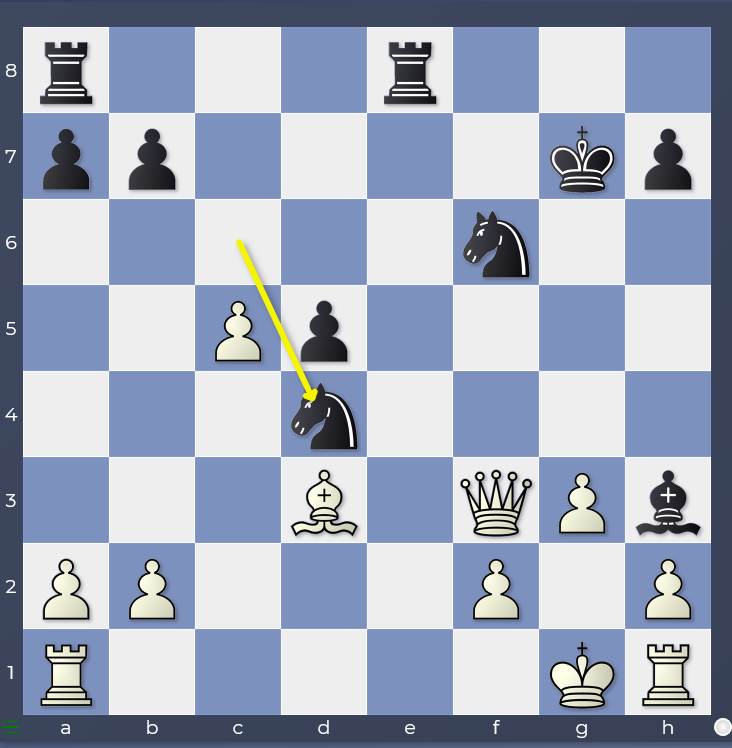
This is 100% correct! 22.Qf4 (22.Qd1 Re1+ 23.Qxe1 Nf3#) 22…Re4 23.Qc7+ Kg8
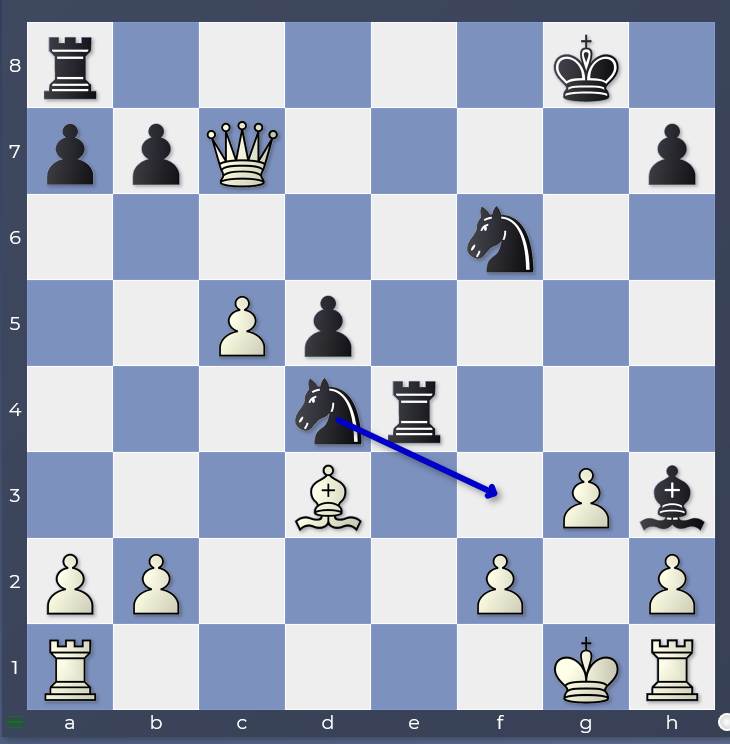
24.f3 Nxf3+ 25.Kf2 Ng4+ 26.Kxf3 Rf8+
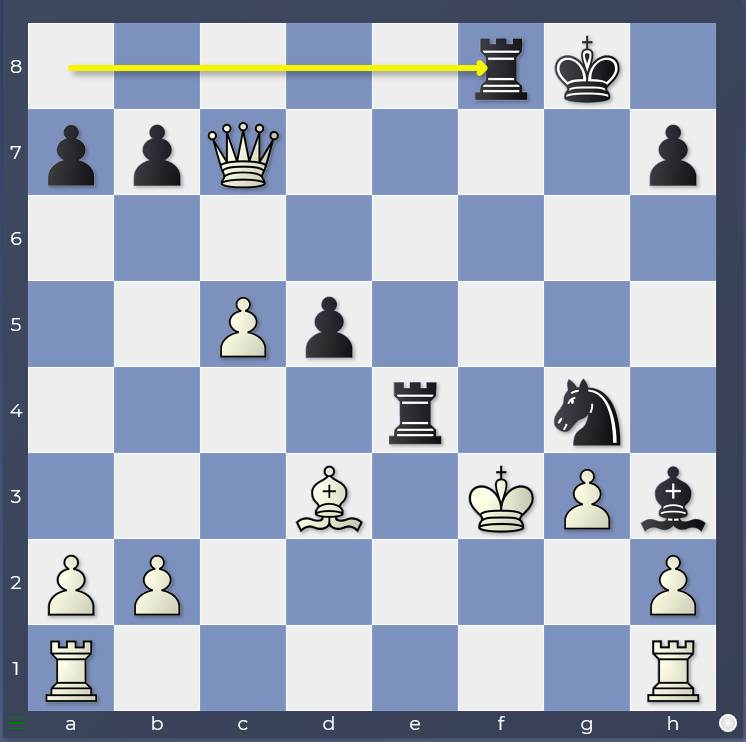
and mate on the next move” This line is given by Spielmann in [TfS]
b) 21.Bf1 is the engine win 21…Bxf1 22.Kxf1 Re2 23.Qb3 Nd4 24.Qxb7+ Kg6 25.Qxa8 Ne4 26.Qg8+ Kh6 27.Qf8+ Kg6 28.Kg1 Rxf2 (28…Nxf2 29.h4) 29.Qd6+
19…Rhe8 20.Be5
[EB] “Here too a) 20.Qxf3 Nxd4 21.Qf4 Re4 22.Qg5+ Kf7 leads to immediate disaster” This line was also given by Spielmann in [TfS];
b) 20.Bf1 [EB] “won’t do either after 20…Bxf1 21.Kxf1 (21.Qxf1 Re2 22.h4 Rae8 23.Qh3 h5 24.Qf5 Nxd4 25.Qg5+ Kf7 and White is helpless”) 21…Re1+ (21…Re2 is the engine move 22.Be5 Nxe5 23.dxe5 Ne4 24.Qxe2 fxe2+ 25.Kxe2 with an advantage to White 25…Re8 26.f3 Nc5 27.f4) 22.Qxe1 Bxe1 23.Kxe1 (23.Rxe1 is much stronger with a big advantage for White) 23…Re8+ 24.Kd1 Re2 “and Black wins the f2–pawn with a decisive, ongoing attack”;
[EB] “However despite this, White still has one last chance to fight back. After c) 20.Qb3, Black did not have an effective continuation” 20.Qb3 Be1 (20…Ng4 21.Bf1 “as the knight can no longer reach e4”) 21.Be5 Nxe5 22.dxe5 Rxe5 23.Qxb7+ The key move …Re7 is not available to Black”]
20…Nxe5 21.dxe5
The cunning intermezzo 21.Bf1 was the best move though White’s advantage has now gone! 21…Bxf1 22.dxe5 Rxe5 23.Kxf1 Re1+ 24.Qxe1 Bxe1 25.Kxe1 (25.Rxe1 d4 26.Rd1 Rc8 27.Ke1 Ne4 and Black is better!) 25…Re8+ 26.Kd2 Ne4+ 27.Kc2 Nxf2 28.Rhe1 Rc8+ 29.Kd2 Ne4+ 30.Ke3 f2 is approximately balanced. 31.Re2 Kf6 32.Kd4 Ke6
21…Rxe5
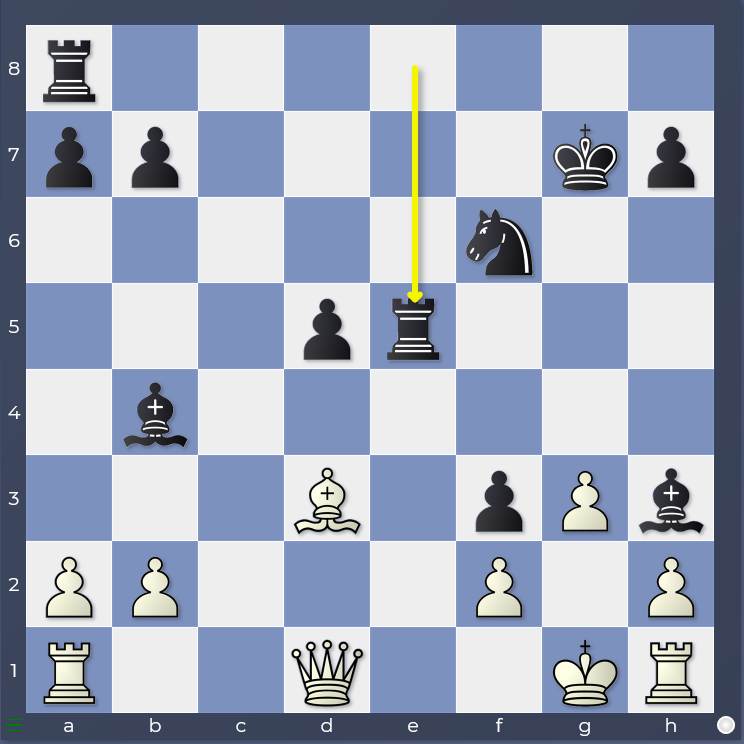
22.Qb3
a) 22.Qxf3 Rae8 leaves White horribly tied up. 23.Rf1 Ne4 (23…h5 is another way 24.a3 Bc5 25.Qd1 Ng4) 24.Qf4 (24.g4 Ng5 25.Qg3 Re1 26.Qf4 Bd2) 24…Rf5;
b) 22.Bf1 Bxf1 (22…Re1 23.Qxe1 Bxe1 24.Bxh3 Re8 25.Bf1 Ba5 followed by …Bb6 and …Ne4/g4 is fine for Black 26.Bd3 Bb6 27.h3 Ne4 28.Bxe4 dxe4 is a clear advantage to Black! …Kf6 and …Rg8 follows with the threat of …Rxg3+) 23.Kxf1 (23.Qxf1 Rae8 24.a3 Ba5 25.b4 Bb6 26.h3 Re2 27.Rh2 Ne4 [EB]“and Black wins with ease”) 23…Re1+ 24.Qxe1 Bxe1 25.Kxe1 Re8+ as above
22…Bc5
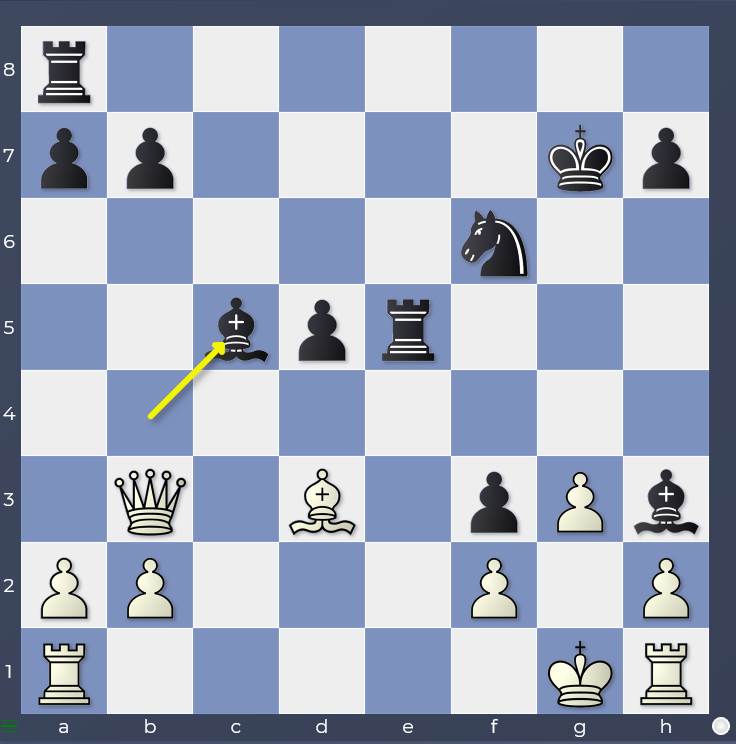
A move that must have shocked Spielmann to his core and confirmed his worst fears about the position.
23.Bf5
a) 23.Qxb7+ Re7 It’s very important that the black king is not forced to move to the third rank. In this way, White doesn’t have any saving checks with the white queen after capturing the rook on a8 24.Qxa8 Ng4 25.Rf1 Nxf2 [EB]
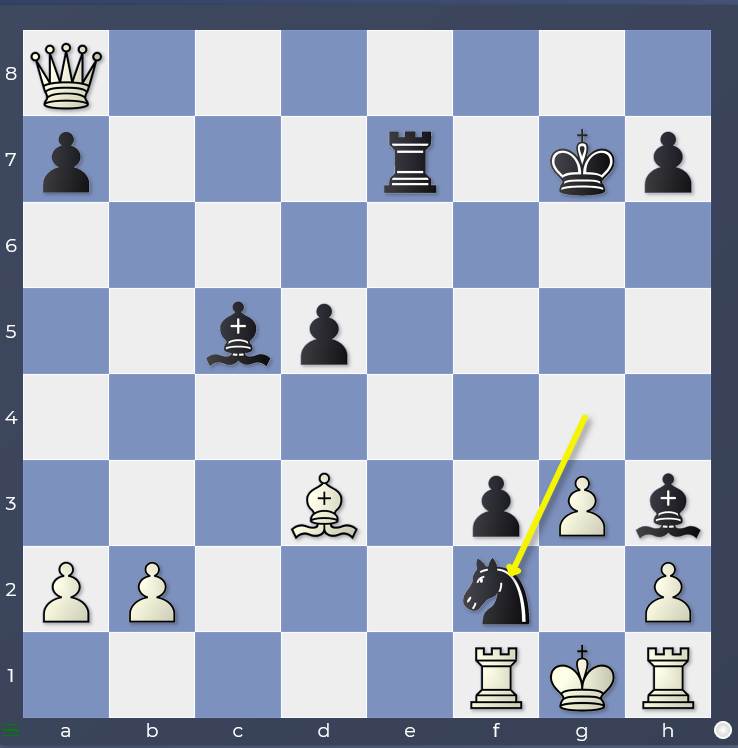
“followed by mate in a few moves” 26.Qxd5 Nxd3+ 27.Qxc5 Nxc5 28.Rxf3 Re1+ 29.Kf2 Rxh1;
b) 23.Bf1 Bxf2+;
c) 23.Rf1 Rc8
The ext desperately tries to deflect the black bishop from h3 to give the white king some room and to gain time for h4 but it simply doesn’t work!
23…Bxf5 24.Qxb7+ Kg6 25.Qxa8 Re2 26.h4
[EB] “The bishop threatened to return to h3”
26…Bxf2+ 27.Kf1 Bd3
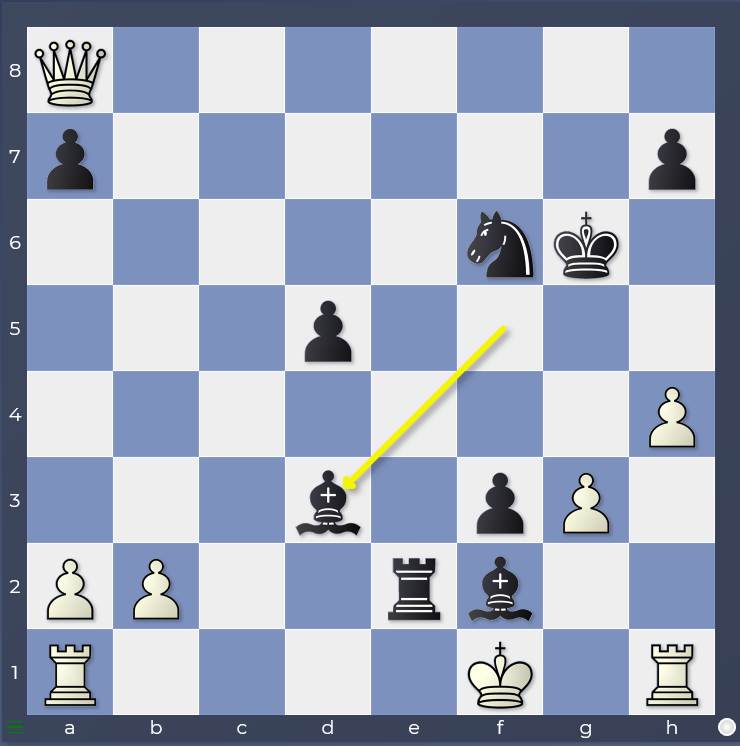
[EB] “The bishop is coming from the other side as it no longer has access to h3”
28.h5+ Kg5 0–1
[EB] “An unusually lively and varied game which caused quite a stir and was regarded as one of the most impressive tactical displays of all time”[
[TfS] “A game that seems like a fairy tale from times gone by and reminds us of the Immortal game Anderssen-Kieseritsky. It was met with enthusiastic applause from the audience, and I would also like to agree with the cheers. This time it was me suffering but the beauty of chess means more to me than a temporary setback”