


Munich 1941 was perhaps Stoltz’ best tournament result ever, finishing 1,5 points clear of World Champion Alexander Alekhine
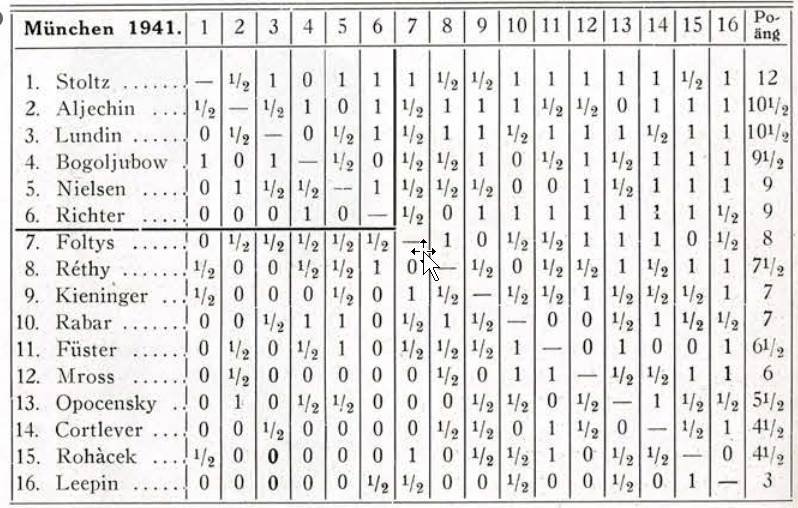
The strength in depth of the field was not so impressive – due in no small measure to the circumstances of the event (the interested reader is referred to “Chess in the Third Reich” by Taylor Kingston (McFarland)) – but to outscore Alekhine by such a margin against such opponents was extremely impressive. In fact Alekhine was leading with first 4.5/5 and then 8/10 but faded allowing the fast-finishing Swedes to catch him! The Swedish magazine “Tidskrift for Schack” (from which all this wonderful material is taken) made a huge report on the event with a photo of Stoltz with his trophy on the October 1941 issue:
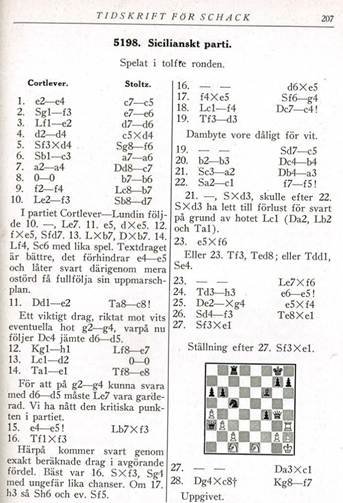
The following sharp game against the Dutch player Cortlever featured a Sicilian Scheveningen which it seems both Stoltz and Lundin had prepared for the tournament.
Cortlever,Nicolaas – Stoltz,Gosta [B84]
Europe Tournament Munich (12), 17.09.1941
1.e4 c5 2.Nf3 e6 3.Be2
[EB] “Alekhine’s recommendation from the 1920s though it merely limits White’s options”
3…d6 4.d4 cxd4 5.Nxd4 Nf6 6.Nc3 a6
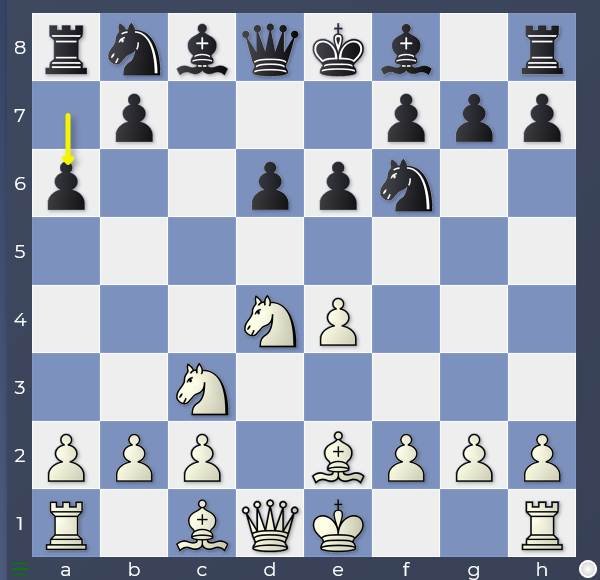
If you’re wondering who the first player was to reach this Scheveningen structure position, the answer is quite surprising: the great Polish player Akiba Rubinstein in a 1922 game against the Russian player Znosko-Borovsky. He played it in good Najdorf style (25 years ahead of time!) emerging with a winning position which he unfortunately failed to convert.
7.0–0 Qc7
Just like 7…Nbd7, Black aims to achieve …b5 as soon as possible, here by anticipating the protection of the bishop on b7 and the reinforcement of Black’s control of e5 against White’s typical counter of f4, Bf3 and e5.
a) 7…Nbd7 8.f4 b5 9.Bf3 Bb7 10.e5 Bxf3 11.Nxf3 b4
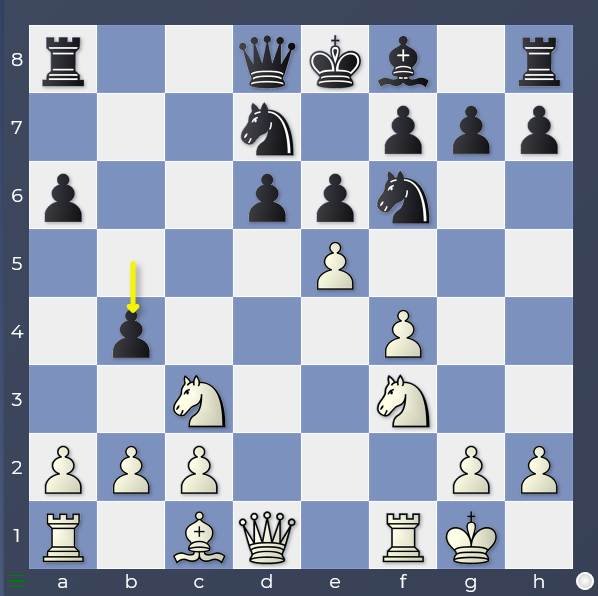
A typical Najdorf resource! 12.Na4 dxe5 13.fxe5 Nd5 14.Kh1 Be7 15.Bd2 0–0 16.c4 bxc3 17.Nxc3 Nxc3 18.Bxc3 Nb6 19.Rc1 Qxd1 20.Rfxd1 Nd5½–½ Znosko Borovsky,E-Rubinstein,A British CF–15 London International 1922 (8);
b) 7…Be7 is by a long distance the most popular move nowadays – indeed, almost the automatic move. 7…Qc7 is however the second-most popular move.;
c) 7…b5 immediately is awkwardly met by 8.Bf3 which essentially forces 8…Ra7 It’s not terrible for Black but the rook on a7 is a touch awkward, subject to further harassment with Be3.
8.a4
[EB] “According to the theoretical manuals, preventing …b7–b5 is a logical and good way to play but it isn’t used very often. Black would now have been advised to play 8…Nc6 and switch to the Scheveningen variation. The form of the Paulsen defence that plays is now considered risky”
Cortlever became something of an expert in this line at the Munich tournament with 3 games (+1 =1 –1) from this position! This was the third game, so we can assume that both Lundin and Stoltz decided that it was important to parry the plan of f4 and Bf3 threatening e5 with a quick …b6 and …Bb7 followed by …Nbd7.
8…b6
a) 8…Be7 9.f4
i) 9…Nc6 Stoltz himself had (a bad) experience with the white side of this line, although the result of the opening was certainly nothing to complain about. 10.Bf3 Nxd4 11.Qxd4 d5 12.Be3 dxe4 13.Nxe4 0–0 14.Nxf6+ Bxf6 15.Qc5 Qb8 16.Rad1 with a big advantage though eventually 0–1 Stoltz,G-Feigins,M Munich Schach-Olympia (No FIDE event) 1936 (5))
ii) 9…b6 10.Bf3 Bb7 11.e5 dxe5 12.fxe5 Nfd7 13.Bxb7 Qxb7 14.Bf4 (14.Qg4 Bc5 15.Kh1 Bxd4 16.Qxd4 0–0 17.Rd1 Ra7 18.Bf4 Nc6 19.Qe3 Ne7 is the engine top line with equality) 14…Nc6 15.Nxc6 Qxc6 16.Qe2 0–0 17.Rf3 f5 18.exf6 Bxf6 19.Rd1 Nc5 20.Be5 Be7 21.Rg3 Rf7 22.Qg4 Bf8 23.Rf1 Raa7 24.Rgf3 Rxf3 25.Qxf3 Qxf3 26.Rxf3 Rd7 27.Kf1 Bd6 28.Bxd6 Rxd6½–½ Cortlever,N-Lundin,E Europe Tournament Munich 1941 (2);
b) 8…Nc6 Following Book’s recommendation. It’s the engine’s top move in my analysis but only by 0.01 from 8…b6! 9.Nb3 Be7 10.f4 Na5 11.Nxa5 Qxa5 12.Kh1 Bd7 13.Bd3 Bc6 14.Qe1 Nd7 15.Bd2 Qc7 16.Qg3 Bf6 17.Rae1 e5 18.Nd5 Bxd5 19.exd5 0–0–0 20.Re4 exf4 21.Qe1 Kb8 22.Ba5 b6 23.Rc4 Qa7 24.Rc6 bxa5 25.Rxa6 Rhe8 26.Qxa5 Qb7 27.Rxf4 Rc8 28.Ra8+ Qxa8 29.Rb4+ Qb7 30.Rxb7+ Kxb7 31.Ba6+ Kb8 32.Qb5+ Kc7 33.Qb7+ Kd8 34.Qxc8+1–0 Cortlever,N-Leepin,P Europe Tournament Munich 1941 (8)
9.f4 Bb7 10.Bf3 Nbd7
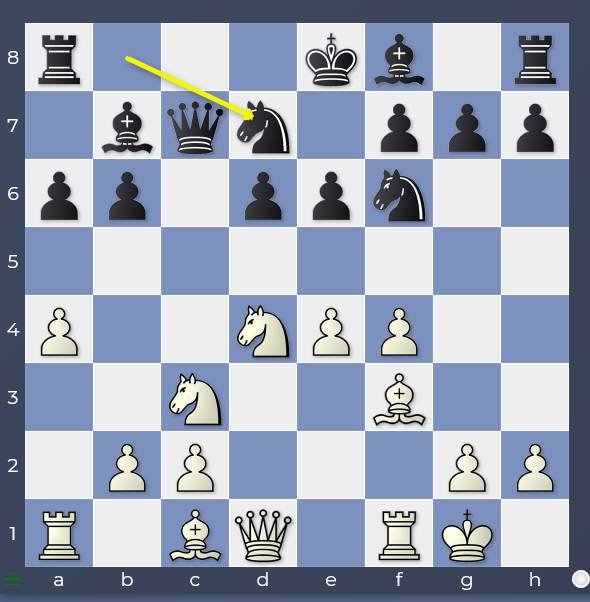
[EB]“White’s best continuation was now 11.Kh1 which threatens to open the position with the dangerous pawn sacrifice 12.e5. The king’s move avoids any possible intermediate moves from c5. White continues a few moves ahead without any particular plan” 10…Be7 [EB] “is bad because of 11.e5”
In fact 10…Be7 simply transposes back to Cortlever-Lundin, and the engines consider 10…Be7 to be the best move! As we shall see below, 10…Nbd7 is not as good at stopping the e4–e5 break as it seems. For that reason, it is better to absorb it with well-placed pieces rather than try to prevent it.
11.Qe2
a) 11.Re1
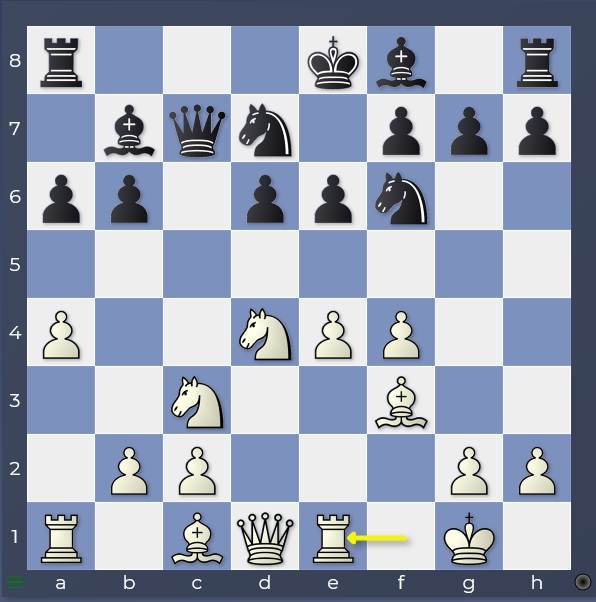
is the top engine move and an unexpected one as the white rook seems well-placed on the f-file. However, the move tees up a couple of threats that are very difficult to handle. The difficulty of the move is demonstrated by the fact that such a player as Vishy Anand (albeit in a blitz game) didn’t find this idea and repeated Cortlever’s 11.Qe2.
So what is White’s threat?
Well let’s try the natural move a) 11…Be7 which is met by 12.e5
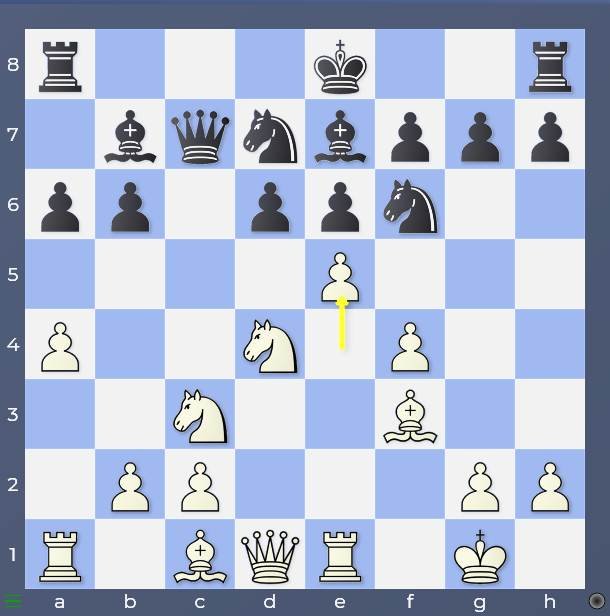
12…dxe5 13.fxe5
i) 13…Nxe5 loses to 14.Bxb7 Qxb7 15.Rxe5 while ii) 13…Bxf3 14.Qxf3 hits the hanging rook on a8
Therefore iii) 13…Ng8 is necessary but 14.Bf4 is wonderful for White.
For that reason, 11…Rc8 is best, sidestepping e4–e5 by taking the rook off the long h1–a8 diagonal.
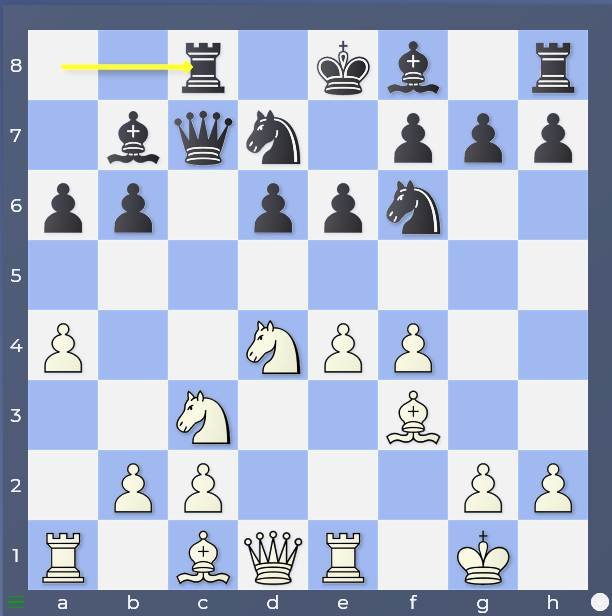
However, now White launches his other power play!
12.Nd5 exd5 13.exd5+ Kd8 (13…Be7 14.Nf5)
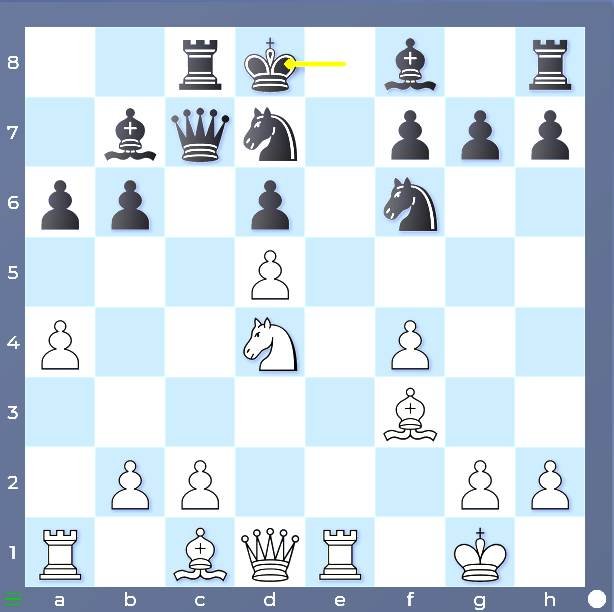
Black’s king has been forced to move, but the d5–pawn is hanging. White has two possibilities.
i) 14.Nc6+ Bxc6 15.dxc6 Nb8 16.Be3 Nxc6 17.Ra3 also looks very dangerous for Black, but an engine can hold this together with concrete action! 17…d5 18.Rc3 (18.Bxd5 Bxa3 19.Bxc6+ Bd6) 18…Bb4
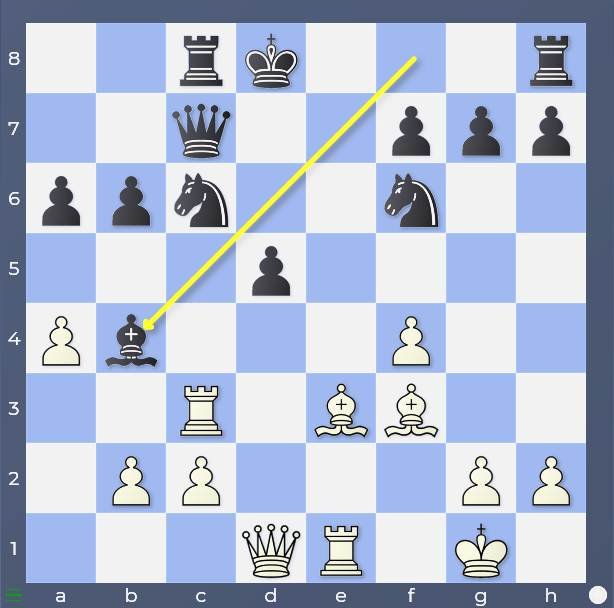
19.Bxd5 Bxc3 20.Bxc6+ Nd7 21.Bxd7 Bxe1 22.Bg4+ Ke8 23.Qxe1 Kf8 24.Bxc8 Qxc8 25.Bxb6 and White holds the balance as Black must force perpetual after 25…Qxc2 26.Qe5 Qc1+ (26…Qc8 27.Bc5+ Kg8 28.Bd4 Qf8 29.Bc5 Qd8 30.Bd4 is another neat draw by repetition)
ii) 14.c4 is the top engine move, ready to consolidate White’s pawn structure with b3 and stifle Black completely
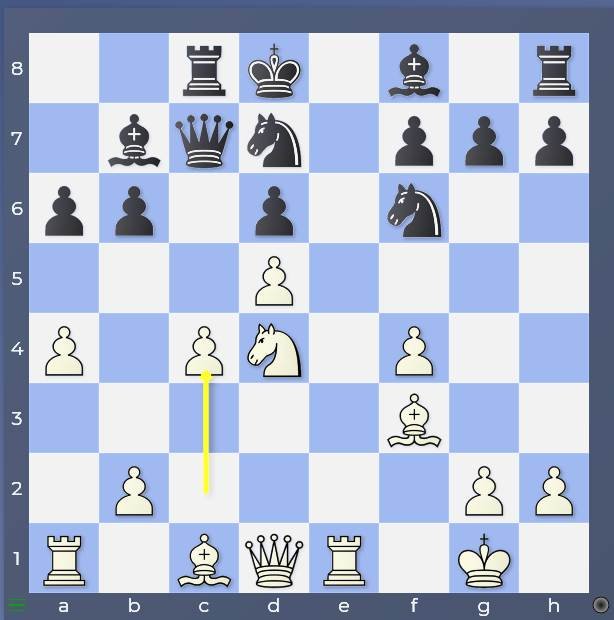
14…Qxc4 Once again, concrete action to thwart White’s idea is advisable. 15.b3 Qc7 16.Nc6+ Bxc6 17.dxc6
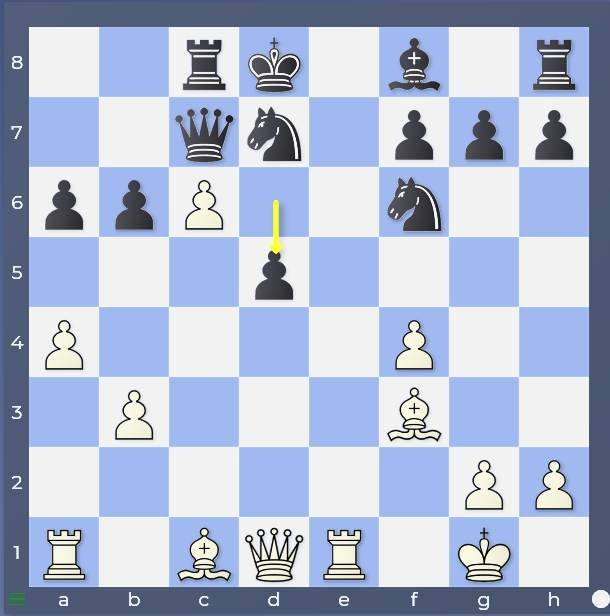
17…d5 It is necessary to return the piece. (17…Nb8 18.Be3 is a much better version for White than after 14.Nc6+) 18.cxd7 Bc5+ 19.Kh1 Qxd7
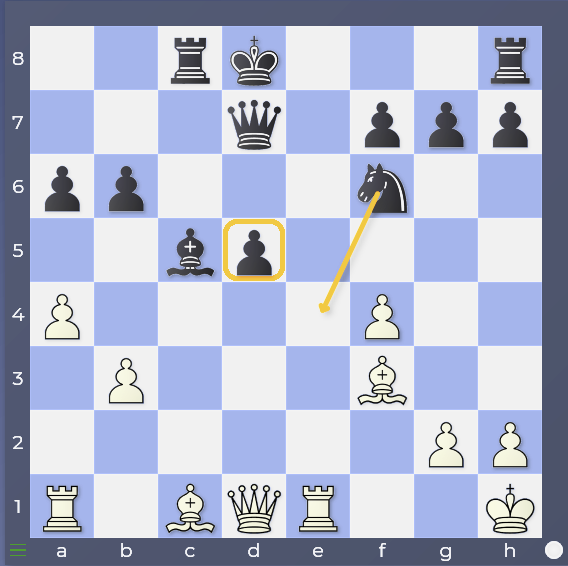
is the engine line. White obviously has great compensation for the pawn with the two bishops and Black’s king precariously-placed in the centre but let the engines run for long enough and they emerge at 0.11 for White. However, it’s obviously far from a picnic for Black!
As a final note, Book’s 11.Kh1 is decent but it certainly doesn’t threaten e5! 11…Be7 12.e5 dxe5 13.fxe5 Nxe5 14.Bf4 Bxf3 15.Nxf3 Bd6 is just an extra pawn for Black.
11…Be7 12.Bd2
Quite a reasonable development idea, intending to support the e4–e5 break with Rae1.
a) 12.e5 dxe5 13.Bxb7 (13.fxe5 Bc5 explains why Book wanted to play Kh1) 13…Qxb7 14.fxe5 Bc5 15.Be3 Nd5 16.Bf2 Nxc3 17.bxc3 0–0½–½ Anand,V (2783)-Navara,D (2737) Saint Louis Blitz 2017 (8)
b) 12.Kh1 is the top engine move but now after 12…0–0 the engines don’t want to force through e5, but want instead 13.g4
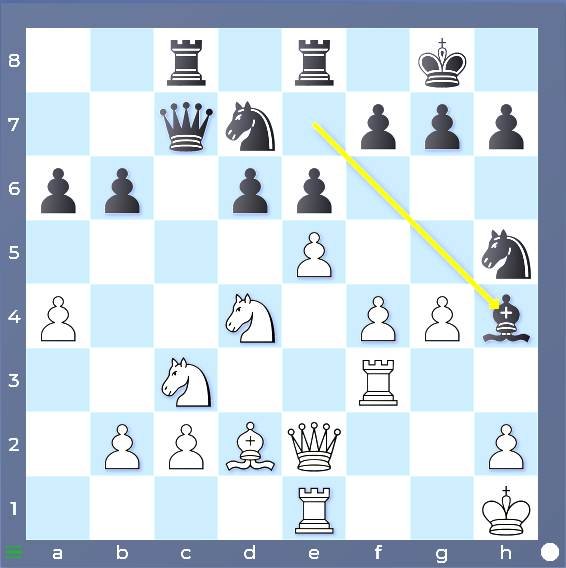
It all feels a little loose along the a8–h1 diagonal, but the engines consider it necessary to sacrifice a pawn with 13…d5 14.e5 Bc5 15.Nb3 Ne4 16.Nxe4 dxe4 17.Bxe4 Bxe4+ 18.Qxe4 Rfd8 19.Qf3 Rac8 It’s just 0.23 for White according to the engines but Black’s compensation is quite fuzzy: some active pieces but some good vision required to keep Black’s activity at the required intensity.
12…Rc8
12…0–0 was more natural, but the text is also decent, introducing the disruptive idea of …Qc4 into the position.
13.Rae1
13.g4 Qc4 14.Qf2 d5 [EB]
13…0–0 14.Kh1
14.e5 dxe5 15.fxe5 Bc5 is still awkward for White. After 14.Kh1, White is ready for the push!
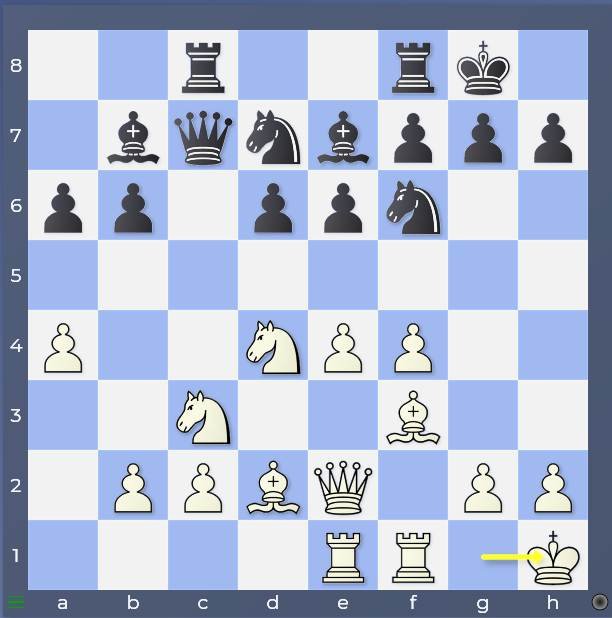
14…Rfe8 [[EB] “Black intends to respond to g2–g4 with …Nf8 along with …N6d7″A natural Sicilian Scheveningen move but here it’s slightly mistimed. The engines suggest some creative alternatives to absorb the threat of e4–e5.
a) 14…h6
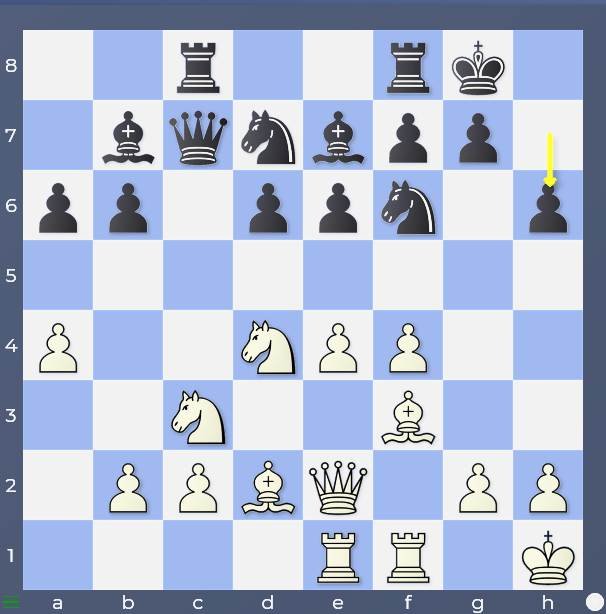
is a cool idea, preparing a refuge on h7 for the knight! It reminded me of Basman’s idea in Owen’s Defence which I believe went something like this: 1.e4 b6 2.d4 Bb7 3.Bd3 e6 4.Nf3 Nf6 5.Qe2 c5 6.c3 Be7 7.0–0 h6
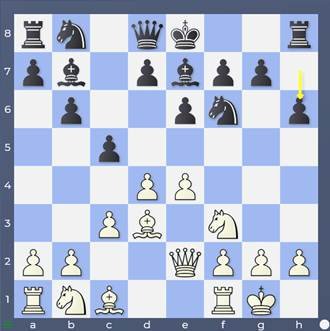
i) 15.g4 is met by 15…Nh7
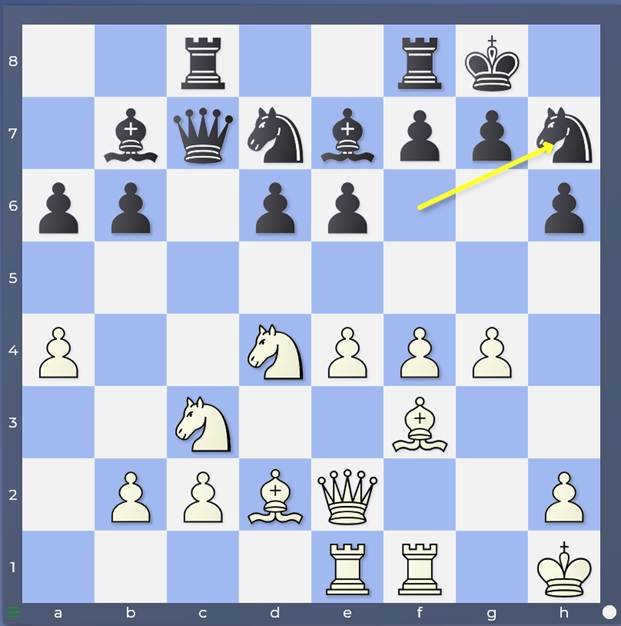
in Hedgehog style when Black follows up with …g5 to fight for the e5–square! It reminds me a lot of the famous game between Karpov and Csom Bad Lauterbeg 1977 where Csom came so close to winning: 1.c4 Nf6 2.Nc3 c5 3.Nf3 e6 4.g3 b6 5.Bg2 Bb7 6.0–0 d6 7.b3 Be7 8.d4 cxd4 9.Qxd4 a6 10.Ba3 0–0 11.Rfd1 Ne8 12.Bb2 Nd7 13.e4 Nc5 14.Qe3 Qb8 15.Nd4 Nf6 16.h3 Rc8 17.g4 h6 18.f4 Nh7 19.Qf2 Ra7 20.Rd2 Ba8 21.Re1 Bf6 22.h4 g5
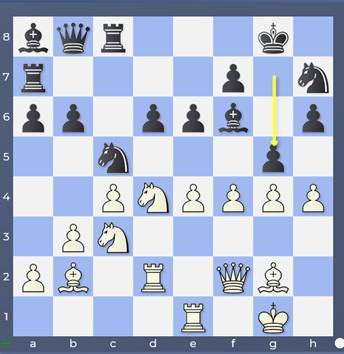
23.hxg5 hxg5 24.fxg5 Bxg5 25.Rdd1 Nd7 26.Rd3 Ne5 27.Rh3 Re8 28.Nce2 Rc7 29.a4 Qd8 30.Qg3 Ng6 31.Qh2 f6 32.Rd1 Rg7 33.Nf3 Bxe4 34.Rxd6 Qc7 35.Ba3 Be3+ 36.Kf1 Bc5 37.Bxc5 Qxc5 38.Rd4 Bxf3 39.Rxf3 Ne5 40.Rh3 Nxg4 41.Qd6 Qf5+ 42.Rf3 Qb1+ 43.Rd1 Qe4 44.Rg3 Ne3+ 45.Kg1 Nxg2 46.Rxg7+ Kxg7 47.Ng3 Qa8 48.Qc7+ Kh8 49.Rd7 Nf8 50.Nf5 1–0
ii) 15.e5 dxe5 16.fxe5 Nh7 17.Bxb7 Qxb7 18.Qg4 Kh8
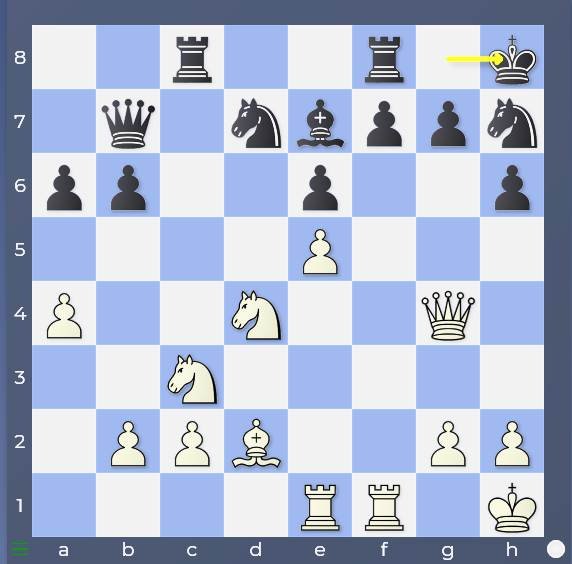
with a typical Sicilian position for Black: less space, but White has created weaknesses and the path through Black’s position is not easy, I loved such positions as Black as a professional!;
b) 14…g6 is also possible meeting 15.e5 with 15…Ne8 followed by …Ng7
Finally c) 14…Qc4 15.Qf2 Rcd8 is a concrete idea, delaying 16.e5 due to 16…dxe5 17.fxe5 Nxe5 18.Bxb7 Rxd4 19.Rxe5 Ng4
15.e5 Bxf3 16.Rxf3
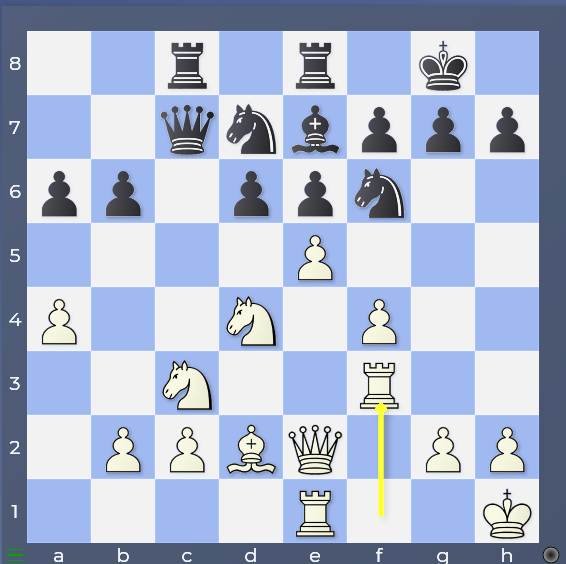
16…dxe5 A very risky move, though to be honest, risk is everywhere now!
a) 16…Ng4 threatens …dxe5 in response to most threats against the g4–knight
For example i) 17.Rh3 dxe5 18.Nxe6 Qc4 is a lovely bit of engine tactics! 19.Qxg4 Qxe6 20.f5 Qc6 21.Bh6 Bf8. ii) 17.Rg3 is the exception and is met by the fearless 17…h5 holding the knight jn its active square and renewing the threat of …dxe5 18.exd6 Bxd6 with …e5 to follow with a really active position for Black.
iii) 17.Nd5
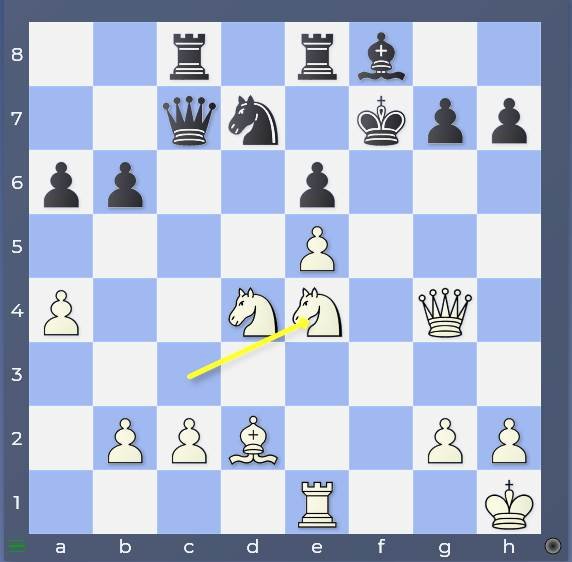
is the engine top move with the cunning point 17…exd5 18.Rc3 uncovering an attack on the g4–knight. It looks quite rough for Black but 18…Nc5 19.Qxg4 g6 20.e6 Bf6
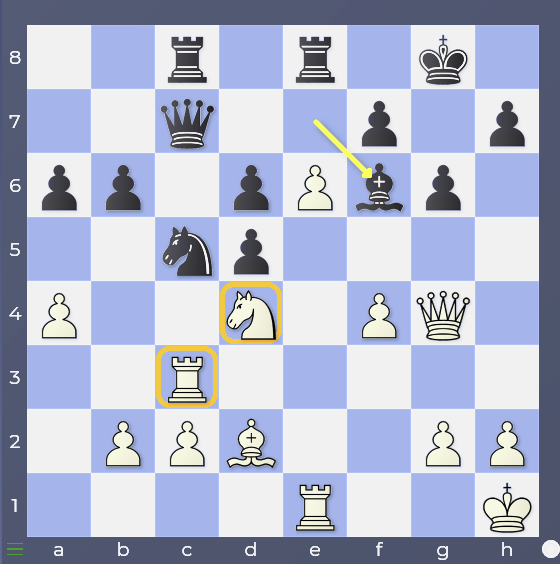
21.f5 fxe6 22.fxe6 Qg7 more or less keeps the balance as White’s pieces are quite awkwardly-placed.
Even b)16…Nh5 is possible which seems implausible due to 17.g4 trapping the knight. However 17…Bh4
18.gxh5 (18.Ref1 Nxf4 19.Bxf4 dxe5 20.Rh3 g5 gets pretty bananas! 21.Bg3 Bxg3 22.Qd3 Threatening Qxh7+ 22…f5 23.Nxe6 Rxe6 24.gxf5 Qc6+ 25.Qf3 Qxf3+ 26.Rxf3 Rd6 27.Rhxg3 Nf6 28.Rxg5+ Kf8 gives Black enough counterplay for the pawn (…Rd2 is coming or …Rd4–b4)) 18…Bxe1 19.Qxe1 dxe5 20.fxe5 Qxe5 21.Qxe5 Nxe5 22.Rg3 f5 is pretty OK for Black. White has two pieces for a rook and pawn but a damaged pawn structure and there are some open and half-open files for Black to work with.
17.fxe5 Ng4
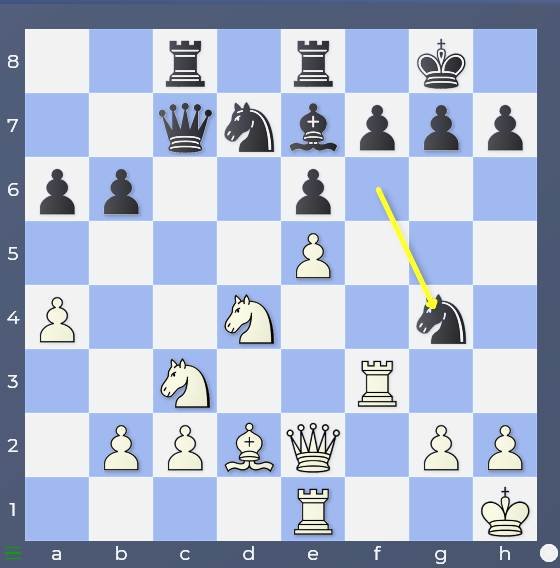
18.Bf4
[EB] “According to grandmaster Samisch, White can immediately sacrifice on f7. This would be followed by 18.Rxf7 Kxf7 19.Qxg4 Bf8 20.Ne4
(20.Nf3 Kg8 21.Ng5 [EB] 21…Qc6 22.Qh5 h6 23.Nce4 Nxe5 (23…Qxc2 24.Nf6+ gxf6 25.exf6 hxg5 26.f7+ Kg7 27.fxe8Q Rxe8 28.Qxe8 Qxd2 [EB] “and Black has managed to escape from White’s grip. Very interesting”) 24.Bc3 Be7 25.Bxe5 Bxg5 26.Nxg5 hxg5 27.Bxg7 “and White wins” [EB] Unfortunately this line is simply incorrect after 21…Nxe5 22.Qh5 h6)
20…Kg8 21.Bf4 Qc4 22.c3 is the engine recommendation with a slight advantage for White (0.32) I think I’d take that as Black however – some pressure definitely but there are dollar signs in my eyes for that extra exchange!
18…Qc4
Now the interesting tactics really start!
19.Rd3
The sharpest attempt from White, defending the knight on d4< avoiding the exchange of queens and attacking the knight on g4.
19…Nc5
Counterattacking against the rook on d3!
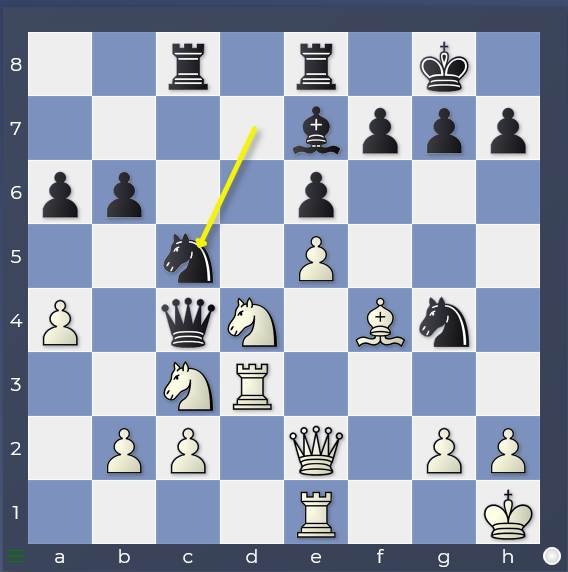
20.b3
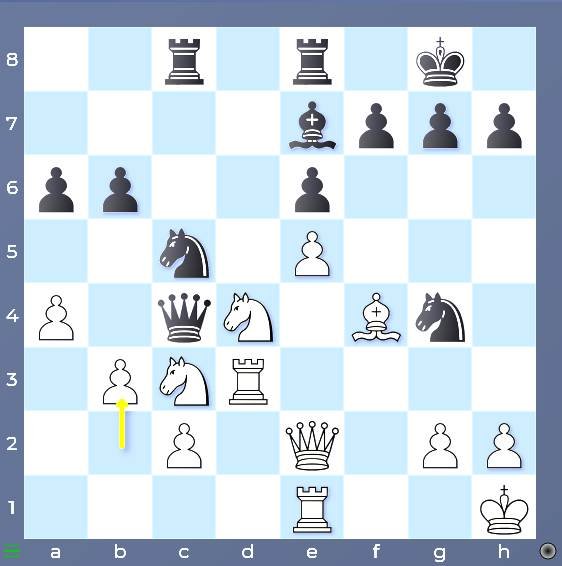
20…Qb4
Obvious, but Black had two interesting tactical possibilities.
a) 20…Nxb3
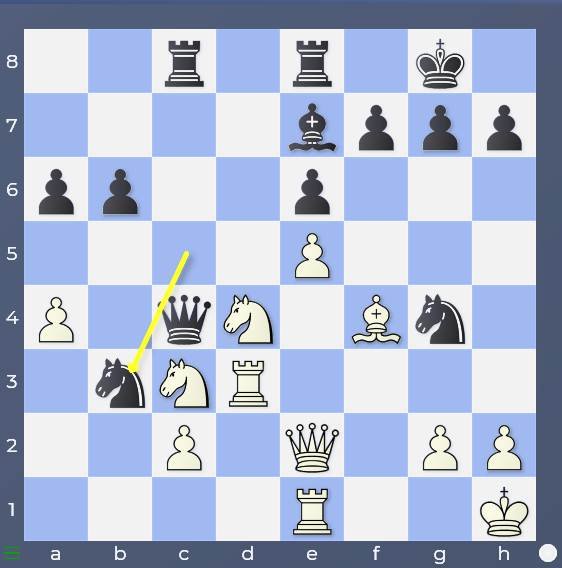
21.Qxg4 (21.Nxb3 Qxf4; 21.cxb3 Qxd3 is the evil trick! 22.Qxd3 Nf2+) 21…Nxd4 looks like it might be decisive for Black but…. 22.Re4
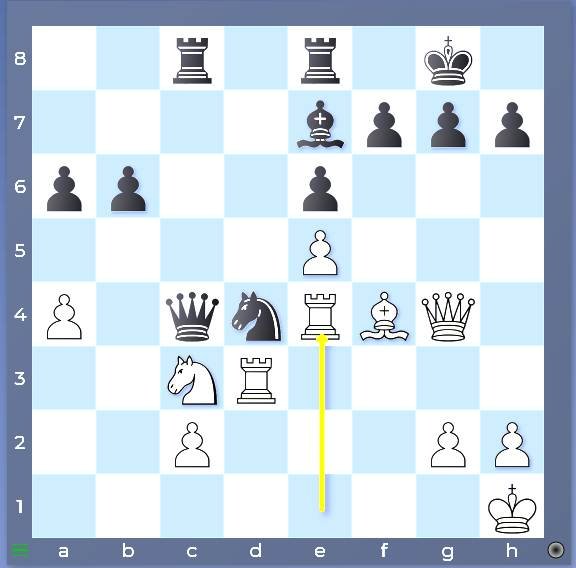
with Be3 in the air is quite nasty! Black must reply 22…f5 23.exf6 Bxf6 when after 24.h3 Qc6 25.Be5 Bxe5 26.Rxe5 Nf5 The engines only see a slight advantage for Black but… it is an extra pawn nonetheless!;
b) 20…Nf2+ is related and might come as a shock to a white player! 21.Kg1 (21.Qxf2 Nxd3) 21…Nxb3
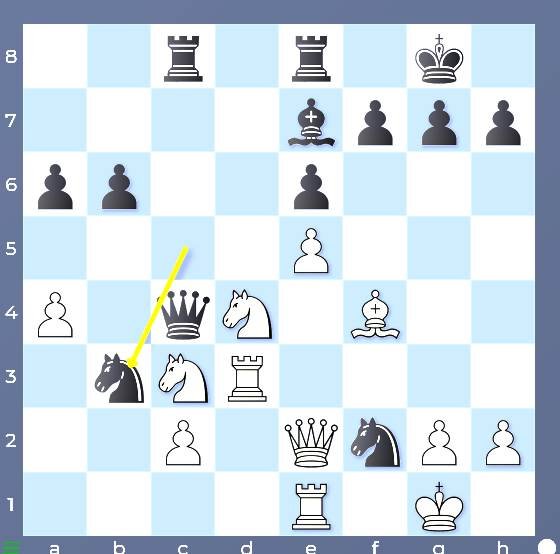
Wow! 22.Qxf2 Nxd4 23.Re4 That pin again! 23…Red8 24.Bd2 f5 Forcing the situation (24…Bc5 25.Be3 is still tricky for the d4–knight!) 25.Rdxd4 Rxd4 26.Rxd4 Qxd4 27.Qxd4 Bc5 28.Qxc5 Rxc5 is better for Black as e5 is doomed but – perhaps surprisingly – the engines settle on just a small advantage for Black. None of this is pleasant for White of course!
21.Na2 Qa3
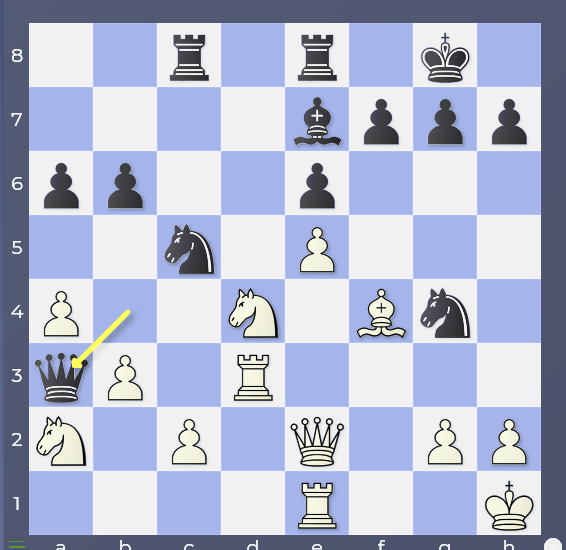
22.Nc1
A really ingenious move from White but not the best.
22.Rg3 [EB] “was better with the following interesting continuation” 22…Qxa2 23.Qxg4 g6 and now Book gives 24.h4 Red8 25.Bg5 h5 26.Qf4 Bxg5 27.Rxg5 Qb2 28.Rd1 Nxa4 29.bxa4 Rc4 30.Qf6 Rdxd4 31.Rxg6+ fxg6 32.Qxe6+ Kg7 33.Qe7+ “and a draw by perpetual”
In fact the engines consider White to be completely winning in multiple ways. One lovely idea is 24.Bd2
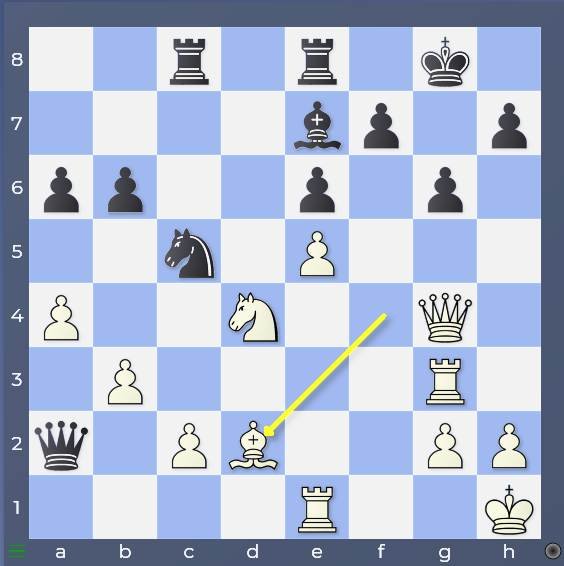
with the idea of Bc3 and Ra1 trapping the queen which is very hard to deal with, especially when combined with Qf4 and Rf3 tying down some black pieces to the defence of f7.
The main move amazingly enough is 22…h5 with the key point 23.h3 Ne4 winning material.
23.c4
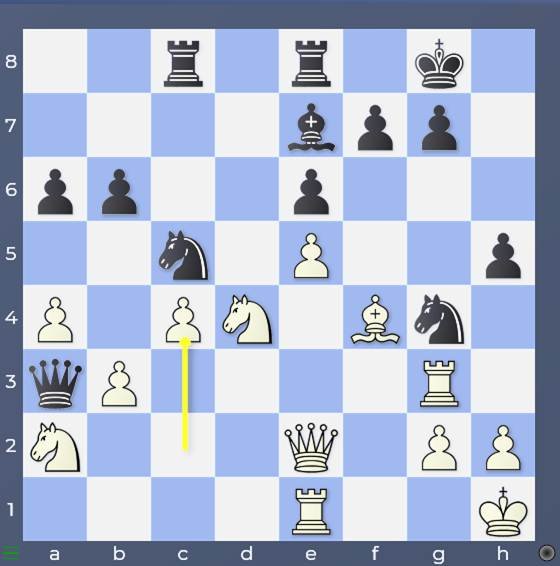
is however fairly vicious, protecting the knight on a2 and with the threats of Bc1 and b4.The line continues 23…Nxb3 24.Rxb3 Qxa4
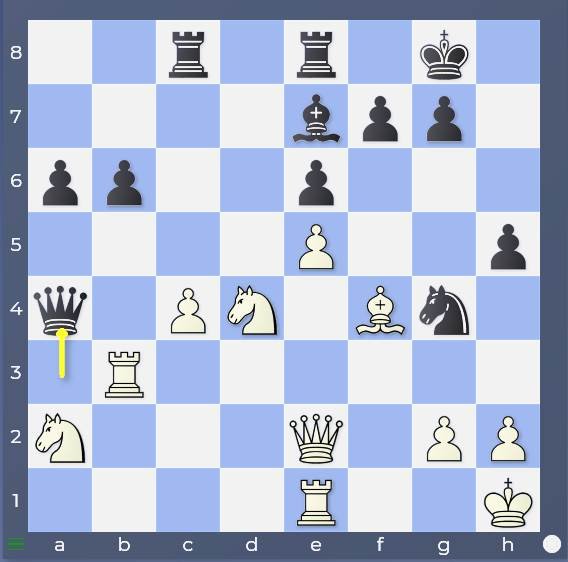
and I would normally shrug my shoulders here and say “desperation from Black, winning for White” were it not for an engine evaluation of 0.00! 25.h3 Red8 26.Rd3 (26.hxg4 Rxd4 and suddenly lots of material is hanging for White.) 26…Rxc4 27.Nc3 Qa5 28.hxg4 Rcxd4 29.Rxd4 Rxd4 30.Ne4 hxg4 31.Rc1 Qb4 32.Rc8+ Bf8 33.Nf6+
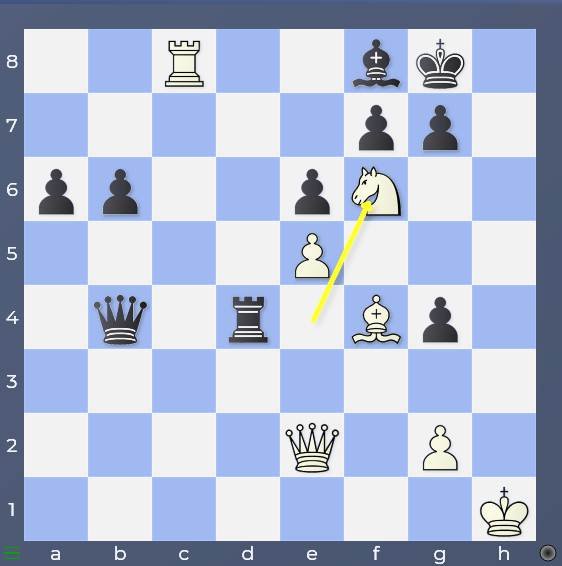
33…gxf6 34.Qxg4+ Kh7 35.Qh4+ Kg8 36.Qg3+ is the wonderful engine draw by repetition! Simply astounding!
22…f5
[EB] “22…Nxd3 23.Nxd3 followed by Bc1–b2 followed by Ra1 trapping the queen.”
The engines of course have something to say about that! 23…h5 is the top engine move 24.h3 (24.Bc1 Qa2 25.Bb2 is met by 25…Bc5 26.Ra1 Qxb2 27.Nxb2 Bxd4 with a great position for Black) 24…Red8 and now best play for the engines is 25.Qe4 (25.Bc1 Qa2 26.Bb2 Rxd4 27.Ra1 Rxd3 28.Rxa2 Rd1+ is very evil!) 25…Bc5 (25…Bb4 is also possible) 26.Nxe6
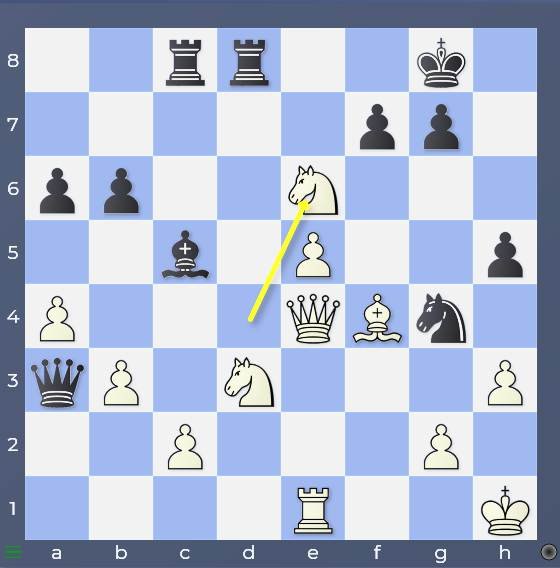
26…Nf2+ 27.Nxf2 fxe6 28.Nd3 Bf8 29.Bg5 Be7 30.Bh6 Bf8 31.Bg5 Be7 which I think you’ll agree is a pretty cool draw by repetition!
23.exf6
[EB] “Leads to an immediate loss”
[EB] “With 23.h3 Nh6 24.Rc3 “White still had possibilities to survive although Black’s positional advantage is obvious”
This is indeed the top engine move… and the engines think that White is a touch better! (24.Bxh6 gxh6 25.Rf3 is also a slight edge for White)
23…Bxf6 24.Rh3
This is the big mistake
a) 24.Rd2 is White’s best when 24…h5 25.Bg3 Bg5 26.Rdd1 Qb2 looks very uncomfortable and passive for White but the engines see only zeroes! 27.Nf3 Be3 28.Ne5 Qxe5 29.Bxe5 Nf2+ 30.Qxf2 Bxf2 31.Re2 with equality
Note that b) 24.Rdd1 Ne4 is killing]
24…e5
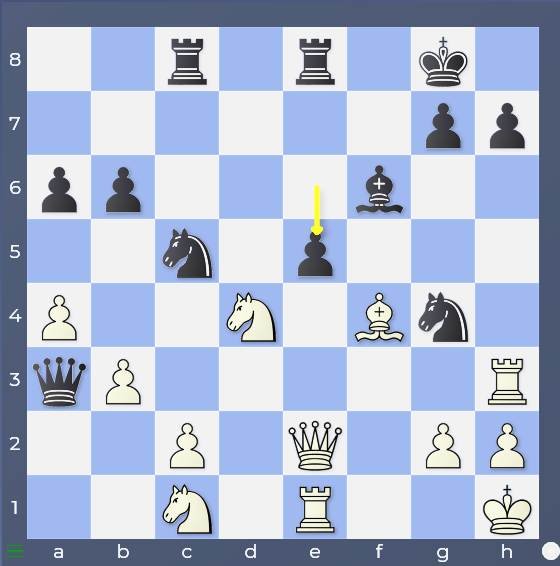
[EB] “The opening of the e-file will be decisive. The rook on h3 is inactive”
That’s a pretty cool move. leaving the knight on g4 en prise while not taking a hanging knight on d4!
25.Qxg4 exf4
White’s back rank is dreadfully weak and the attack of the wayward queen on a3 on the knight on c1 turns out to be very painful!
26.Nf3 Rxe1+ 27.Nxe1 Qxc1
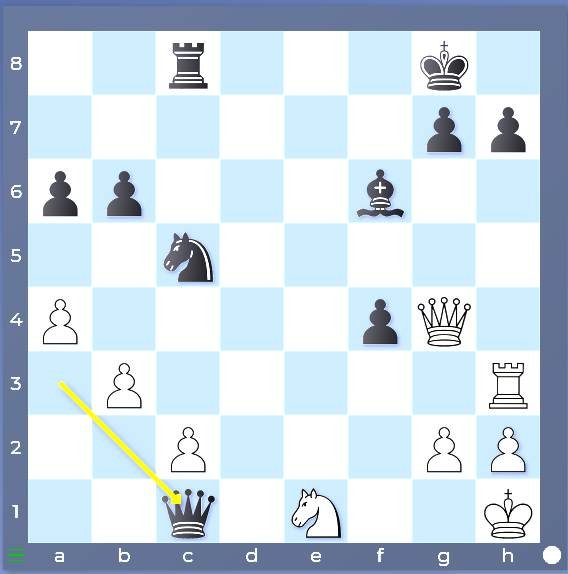
[EB] “Strangely enough, Black may allow White to capture the rook on c8 with check”
28.Qxc8+ Kf7 0–1
28…Kf7 29.Qc7+ Ke8 30.Qb8+ Ke7 31.Qc7+ Nd7 and it’s all over – White cannot protect e1
[EB] “Stoltz has addressed the difficult middlegame play with combinations of imagination and precision”