


The elite Groningen 1946 tournament is most remembered fort he hug battle between Botvinnik and Euwe for first place but our hero Stoltz was also there, finishing in a creditable 9th place in a star-studded field. (Thanks as always to Tidskrift for Schack for all this wonderful information)
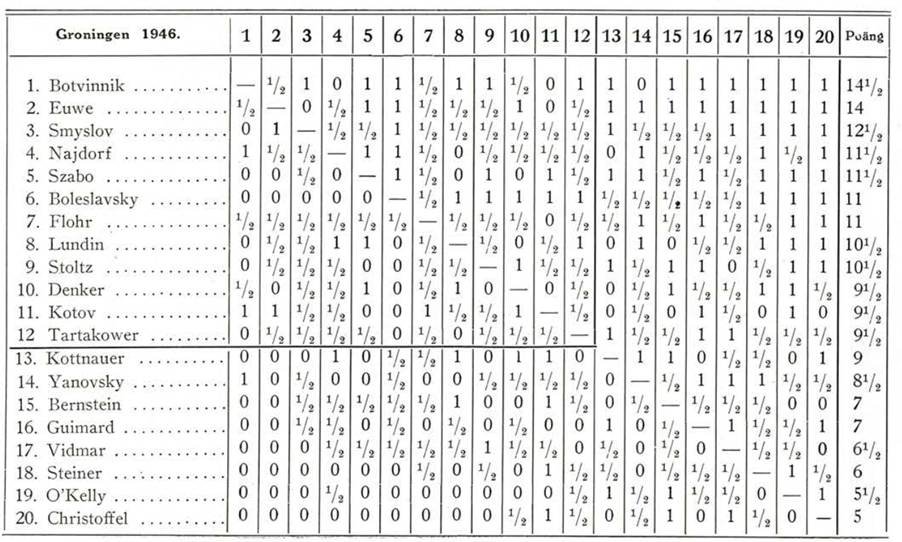
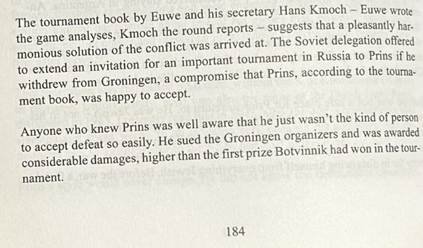
However, the tournament itself was not without drama. Too many players arrived to play the tournament and it was necessary to jettison one player. Since no one wanted to “volunteer” even with the incentive of 1000 guilders in compensation, the Dutch player Prins was prevailed upon to withdraw. I mentioned this on X and one of my friends replied with this additional information taken from a book by Hans Ree!
The following fine win by Stoltz was extremely interesting and the engines chip in with loads of nice details!
As always, comments marked [EB] are translations of annotations by E. Böök in his “Stormästaren Gösta Stoltz bästa partier”
[TfS] are fromthe wonderful resource “Tidskrift for Schack” (https://tfsarkiv.schack.se/pdf/1946/tfs_1946_0809.pdf)
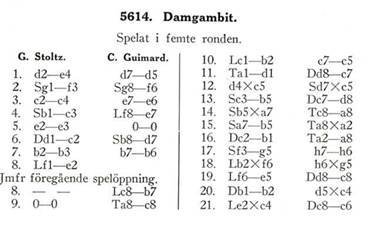
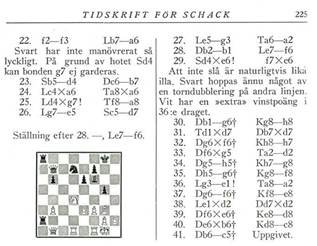
Stoltz,Gosta – Guimard,Carlos Enrique [D37]
Staunton Memorial Groningen (5), 17.08.1946
1.d4 d5 2.Nf3 Nf6 3.c4 e6 4.Nc3 Be7 5.e3 0–0 6.Qc2
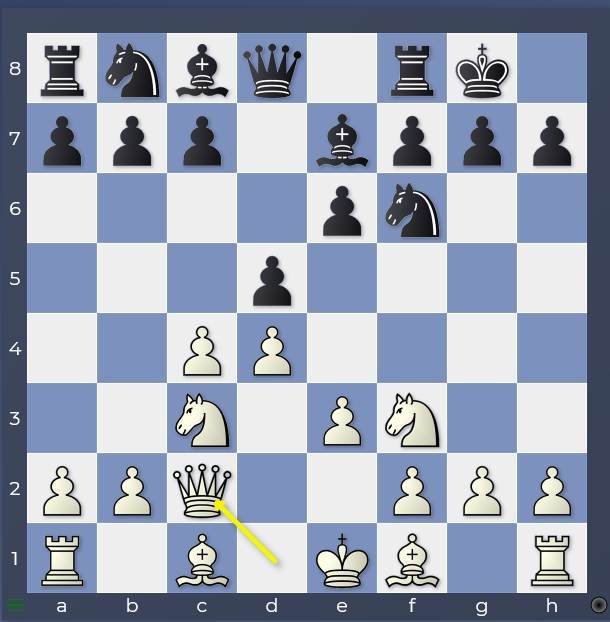
[EB] “This move by the queen isn’t the best here. White reveals his intentions too early and makes Black’s play easier. The difference with the 6.Qc2 line against the Meran [1.d4 d5 2.c4 c6 3.Nf3 Nf6 4.Nc3 e6 5.e3 Nbd7 6. Qc2 which Stoltz played a lot] is that the c-pawn is played to c5 in one go”
It’s funny to think that reading this in the 1990s, I would have agreed completely with this statement. However, from the “engine fuelled” 2020s where essentially every line is equal and players delve deeper and wider in order to discover promising avenues in lesser(-known) lines, it seems rather old-fashioned! Although this approach is not common nowadays, we see elite players like Erigasi and MVL trying it as well as a decent number of 2500 and 2600 grandmasters.
Its originator was Akiba Rubinstein who defeated a young Gideon Stahlberg in the 1930 Hamburg Olympiad (contributing to his mammoth 15/17 top board score that helped bring home team victory for Poland) using it as a way to segue into a Pillsbury formation after hinting at many other things (his early 7.Bd2 made you think of queenside castling)Stoltz started off in calm mode with this game, but then moved into caveman mode in his next games by castling queenside at the earliest opportunity!
6…Nbd7
6…b6 7.Bd2 Bb7 8.cxd5 exd5 9.Bd3 Nbd7 10.0–0 c5 11.Ne5 Rc8 12.Rad1 g6 13.f4 cxd4 14.exd4 Ne4 15.Qa4 Nxe5 16.fxe5 Nxd2 17.Rxd2 Bc6 18.Qd1 Bg5 19.Re2 Bd7 20.h3 1–0 Rubinstein,A-Stahlberg,G Olympiad–03 Hamburg 1930 (6) was the stem game mentioned above
6…b6 7.b3 c5 8.Bb2 cxd4 9.Nxd4 Bb7 10.0–0–0 Nc6 11.Nxc6 Bxc6 12.cxd5 Nxd5 13.Ba6 Qb8 14.Nxd5 Bxd5 15.Kb1 Bb7 16.Bd3 Rc8 17.Qe2 Rc5 18.f4 Qc7 19.Rhf1 Rd8 20.e4 Qc8 21.f5 exf5 22.exf5 Bf8 23.g4 1–0 Stoltz,G-Lundin,E Zonal Helsinki 1947 featured Stoltz’ queenside castling approach!
7.b3 b6 8.Be2N
8.Bd3 Bb7 9.Bb2 c5 10.0–0–0 Rc8 11.e4 cxd4 12.Nxd4 Bc5 13.Nf3 d4 14.Ne2 e5 15.Ng3 Bd6 16.Kb1 Nc5 17.Qe2 a5 was a deeply unsatisfactory opening for Stoltz against the English master. 0–1 Stoltz,G-Wood,B Aalborg 1947 (5)
8…Bb7 9.0–0 Rc8 10.Bb2 c5 11.Rad1
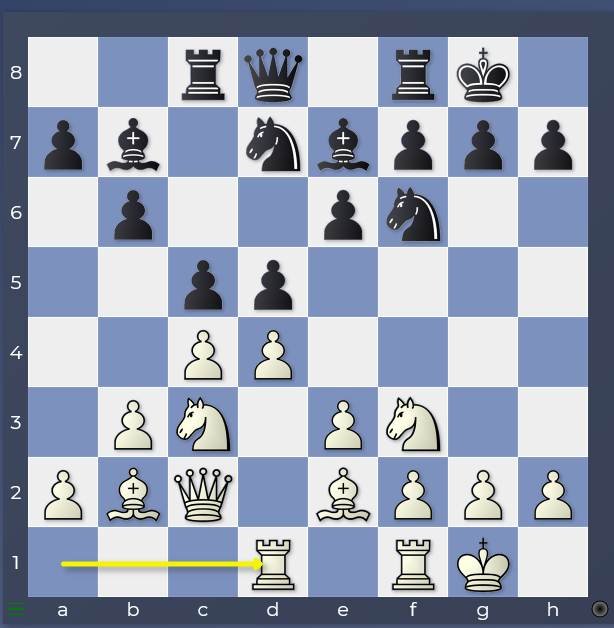
It feels more natural to put the rooks on d1 and c1 while the possibility of hanging pawns (after pawn exchanges on d4 and c4) is quite likely but 11.Rad1 is quite sensible too.
11…Qc7
By far the most common move in this position and a natural one: Black takes his queen off the d-file and plays a waiting game with the central tension.
[EB] “White can allow the exchanges” 11…dxc4 12.Bxc4 Bxf3 13.gxf3 “when the two bishops compensate for White’s damaged pawn structure”
12.dxc5 Nxc5
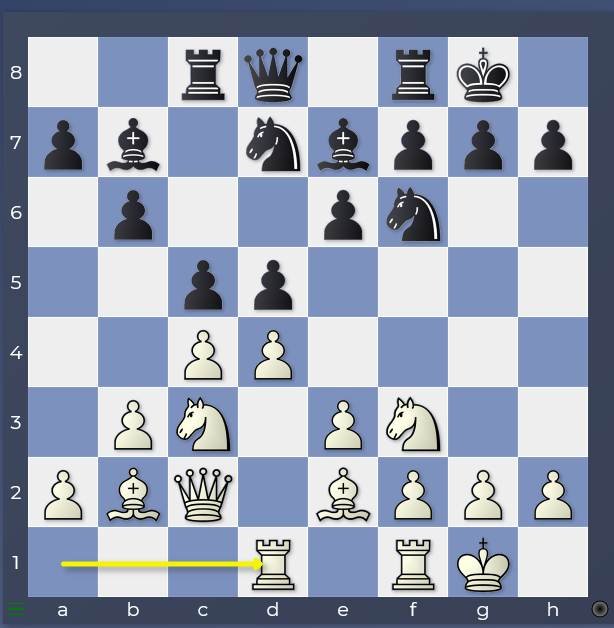
[EB] “A careless move which gives White an opportunity to take the initiative. Black’s best response would have been 12…bxc5 which might lead to a hanging pawns structure.”
Indeed, 12…Nxc5 is by far the worst of all Black’s possibilities. Book’s 12…bxc5 is fine, while 12…Qxc5 is the engines’ favourite.
12…Nxc5 unfortunately makes complete sense of White’s development scheme: the queen on c2 eyeing the h7–pawn, the bishop on b2 leering at the knight on f6 from afar, the knight on f3 ready to jump into g5 to attack h7. the rook on d1 pressuring the d5–pawn… and the queen on c7 gives White the opportunity to unfurl this attacking power with tempo!
[EB] “However 12…Bxc5 “would lead to an isolated queen’s pawn position as” 13.cxd5 Nxd5 14.Nxd5 Bxd5 15.Ng5 f5 16.Bc4 “would be very strong for White” [The engine points out that 16.Bxg7 Kxg7 17.Rxd5 would be even stronger… but that’s not important]
There is however a rather cool flaw in Book’s line and it arrives here:
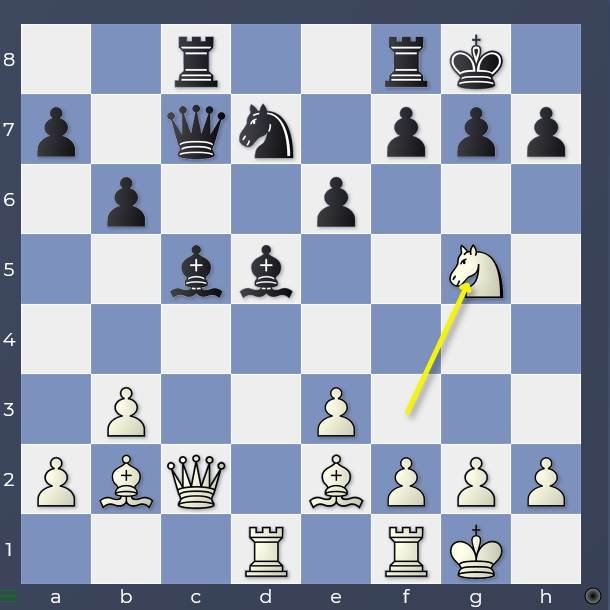
Can you spot it?
15…Qxh2+ 16.Kxh2 Bd6+ 17.f4 Rxc2 wins the house for Black! For this reason even 12…Bxc5 is acceptable for Black if not the best option.
13.Nb5 Qd8
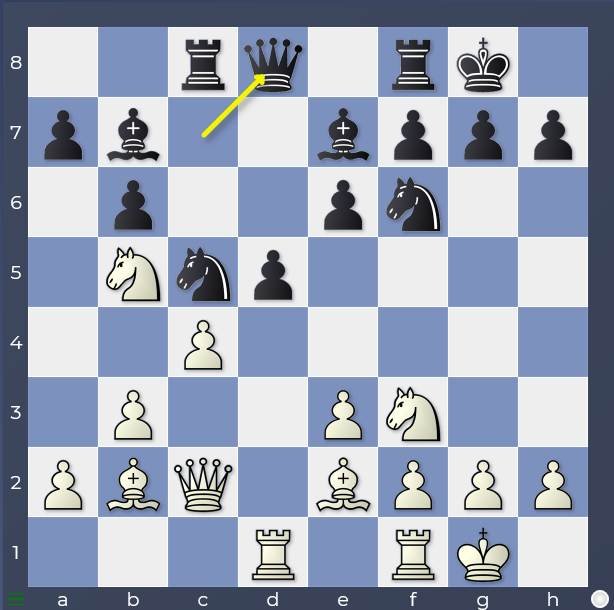
An unfortunate necessity. Oddly enough, Black is not yet lost but he does have a great deal more to think about than he would expect in such a quiet opening! The position is however slightly frustrating for White – at least, I would be getting a bit grumpy if I had the white pieces! It feels as if Black has made a fairly major error: gifting you two tempi, some open lines against the king and a hanging pawn on a7. However, there’s no clear path to a solid advantage – every advantage you find has a little “but” and “however” to it! During a practical game, you can even start to doubt yourself, wondering whether you are just missing something obvious. In fact, White has a few ways to get something between 0.4 and 0.8 (depending on engine depth) but that’s as good as it gets!
13…Qb8 14.Be5 Qa8 15.Nc7 simply wins the exchange for White. This actually occurred in a game featuring a young English talent Frankie Badasconyi (featured here if you want to know more about him!: https://www.youtube.com/watch?v=2XZo5H95uco) 15…Rxc7 16.Bxc7 dxc4 17.bxc4 Be4 18.Qc1 Rc8 19.Bd6 Bd8 20.Qa3 Ne8 21.Bg3 Bf6 22.Ne1 h5 23.Bxh5 g6 24.Be2 Kg7 25.f3 Bc6 26.e4 Nc7 27.Nd3 Be7 28.Qc3+ f6 29.Nxc5 Bxc5+ 30.Bf2 Be7 31.c5 Ba4 32.Rc1 bxc5 33.Qa5 Qc6 34.Bxc5 Bxc5+ 35.Rxc51–0 Haydon,D (2317)-Badacsonyi,F (1789) London Mindsports Rapid 2022 (5.3)
14.Nxa7
One of many tempting moves. The slight irritation for White is that 11.Rad1 unprotected the a2–pawn so that White is not going to win the a7–pawn for nothing.
a) 14.Ng5 is met quite adequately by 14…g6 when despite the weakening of the a1–h8 diagonal, White doesn’t have any meaningful way to exploit it.;
However b) 14.cxd5 is an independent and severe test of Black’s position. 14…Na4 is the engine’s best riposte 15.Qb1 Nxb2 16.Qxb2 Nxd5 and now Black has to venture this extraordinary move to keep Black’s disadvantage within bounds. 17.e4
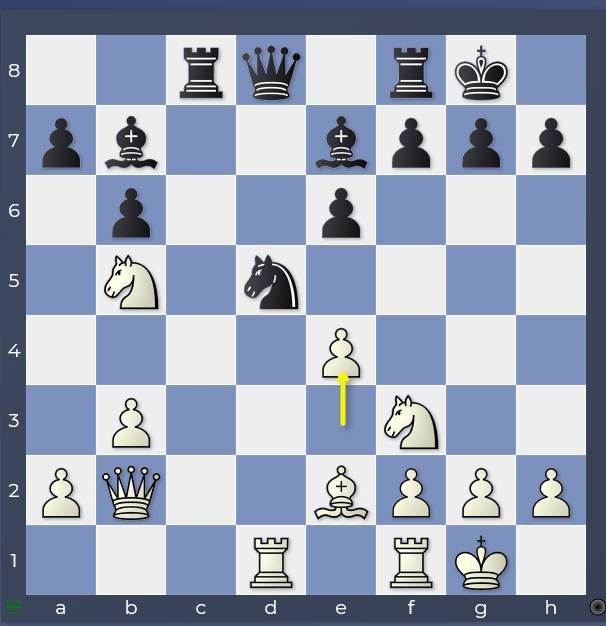
The most critical and seemingly winning material 17…Bf6
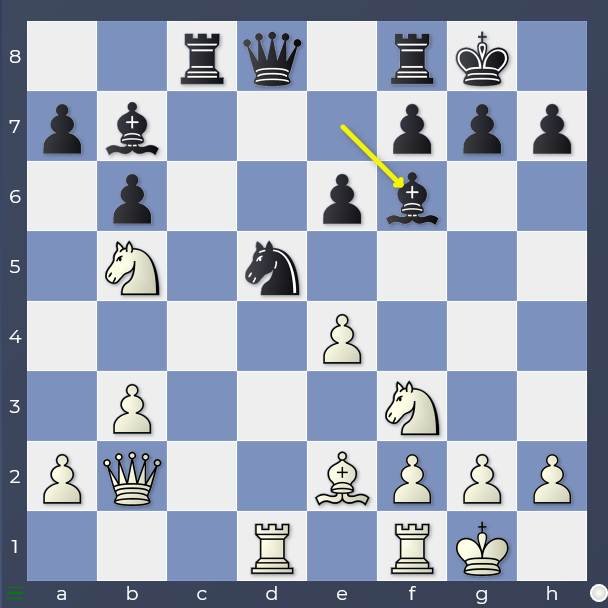
and now it isn’t clear how to deal with the attack on the white queen.
The most natural a)18.Qb1 is surprisingly met by 18…Nf4 19.Rxd8 Nxe2+ 20.Kh1 Rfxd8
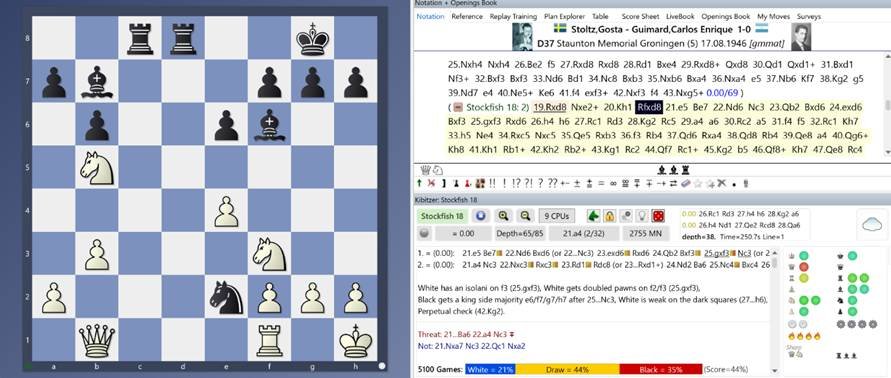
I lazily assumed at first glance that with the queen for rook and piece and the a7–pawn hanging, White should be able to claim a solid plus but a second glance shows that Black’s pieces are indeed very active. The engines assess it at 0.00 and quite intriguingly, the Monte Carlo result (across nearly 16000 games) is just 36% for White! A good example I guess of a 0.00 position that is quite possible to lose!
b) 18.Ne5 is the strongest according to the engines.
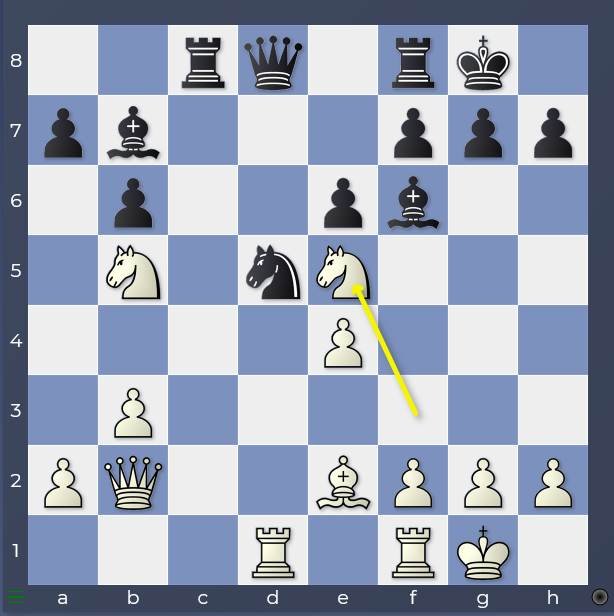
The frustrating thing is that White doesn’t end up winning any material at all after the ingenious 18…Bxe5 19.Qxe5 Qf6 20.Qxf6 Nxf6 but 21.Nd6 Rc7 22.e5 Nd5 23.Rc1 Re7 24.f4 is 0.53 for White.
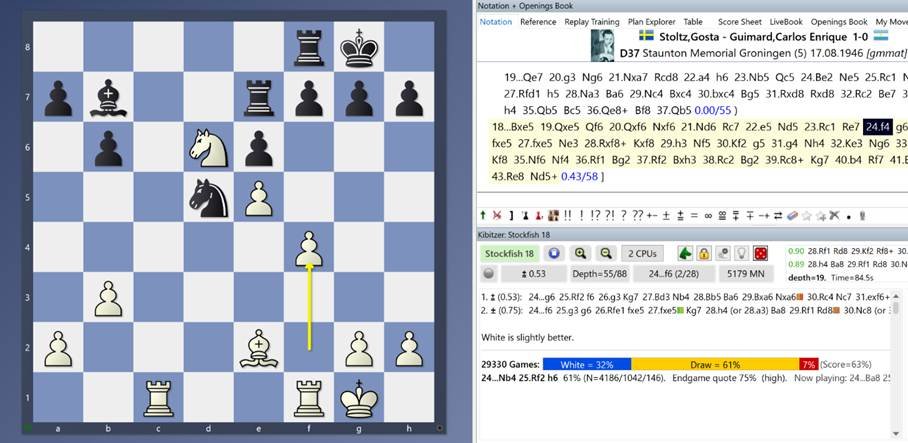
In that case, the Monte Carlo result (over nearly 30000 games) is 63%: 32% White wins, 61% draws and just 7% losses. In general, a pretty pleasant situation for White from such a quiet opening!
14…Ra8 15.Nb5
Stoltz decides to give back the pawn to maintain his chances against the black kingside.]
15.Bxf6 was possible to maintain White’s material advantage 15…Bxf6 16.Nb5 and now the logical line 16…Qe7 17.cxd5 Bxd5 18.Nd2 Rfc8 19.Qb1 Bc6 20.a4 is assessed by the engines as just 0.30, Black’s two bishops seemingly compensating for a large part for the pawn deficit. The Monte Carlo result is 60% over nearly 17500 games which indicates a nice plus for White but nowhere near decisive.
15…Rxa2 16.Qb1
There are other moves but unpinning the bishop and teeing up Ng5 was clearly Stoltz’ idea when he returned the material.
16…Ra8
Black remains cautious. [16…Qa8 was preferred by the engines but to the human eye, the rook on a2 seems quite vulnerable while the black queen can be harassed by moves like Nc7. I can imagine Guimard’s choice for the more compact 16…Ra8.
17.Ng5
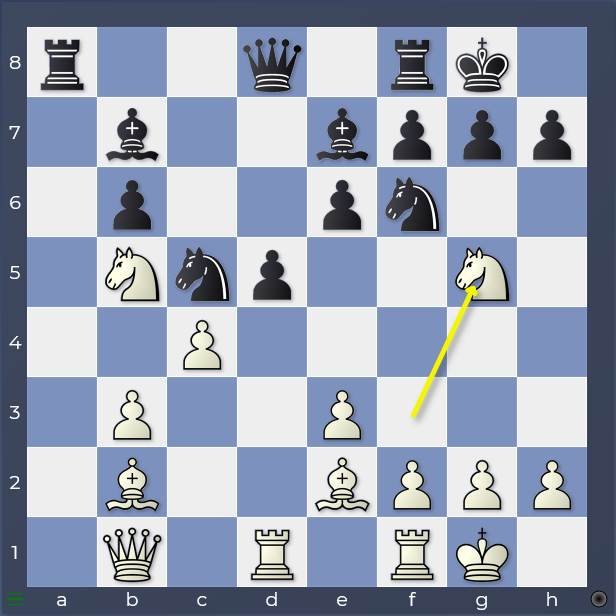
And here it comes! White threatens Bxf6 and Qxh7+ mate
17…h6
[EB] “Looks much more natural than 17…g6 which seems to weaken the long diagonal. However, it is difficult to see how White could make use of it”]
17…g6 is possible, though the engines prefer Guimard’s move which is more concrete and forcing. 18.b4 ([EB] 18.Qc2 Nfd7 19.Nf3 Bf6 20.cxd5 Bxd5 is a not very exciting line from [EB]!) 18…Nce4 19.Nxe4 Nxe4 20.Bf3 Qc8 21.Qd3 Ra2 22.Ba1 is the engine line with an appreciable advantage for White due to the threat of Qd4 threatening mate while attacking the pawn on b6.
18.Bxf6 hxg5 19.Be5
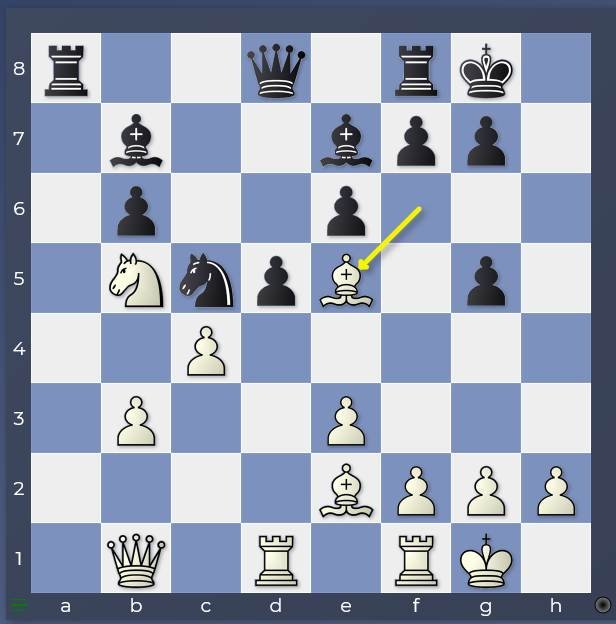
19…Qc8
A natural way to duck the threat of Bc7 and step out of the opposition of queen and rook on the d-file. However, it’s not too energetic and passes the initiative back to White. The engines prefer the more concrete and challenging 19…Bf6 when 20.Bc7 Qc8 21.Bxb6 can be met tactically by 21…Qc6 22.Bxc5 dxc4 threatening mate on g2 23.Bf3 Qxc5 24.Bxb7
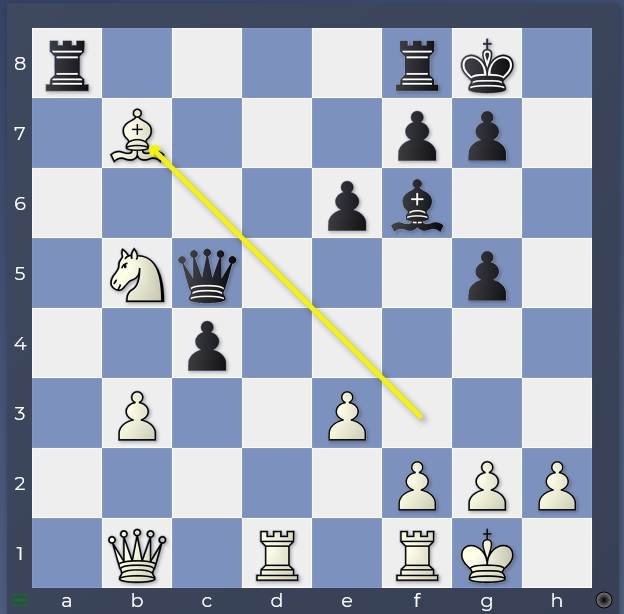
Seems to win material but 24…Ra1 counterattacks the queen 25.Qe4 Rxd1 26.Rxd1 Qxb5 27.bxc4 Qb3 when White’s extra pawn is not too serious as Black’s kingside is well protected against White’s light-squared bishop – the pawn on e6 and f7 are crucial in this respect – while it won’t be easy to advance the c-pawn. The engines show good ways to keep the black pieces active and irritating! For example: 28.Rb1 Rd8 29.g3 (29.Rxb3 Rd1#) 29…Qa2 30.Rf1 Be7 31.Bd5 Qa5 32.Bc6 g6 33.Bb5 Rd2 34.Qf3 Kf8 35.Rd1 Ra2 I’m slightly surprised by the way that the engines don’t want to exchange rooks as I can’t imagine the queen and bishop endgame being anything tricky for Black. And indeed, checking the evaluations, the difference is minimal!
20.Qb2 dxc4
[EB] “After 20…f6 21.Bc7 (21.Bd6 Qd7 22.Bxc5 Bxc5 23.cxd5 exd5 24.b4 Bd6 25.Qb3 Rae8 26.Nxd6 Qxd6 27.Rd4 is the engine line with a big advantage for White but Book’s line also gives White a solid plus) 21…dxc4 (21…Bd8 22.Bd6 Rf7 23.Bh5 “wins the exchange”; 21…Nd7 22.Bd6 Qd8 23.Bxe7 Qxe7 24.cxd5 Bxd5 25.Nc7 “leads to the loss of a pawn”) 22.Bxc4 Bc6 23.Bd6 Bxb5 24.Bxb5 Bxd6 25.Rxd6 Qb8 26.Rfd1 “and White is in a better position due to his mastery of the d-file and Black’s weakened king’s position”
21.Bxc4
21.Bxg7 Qc6 [EB]
21…Qc6 22.f3 Ba6
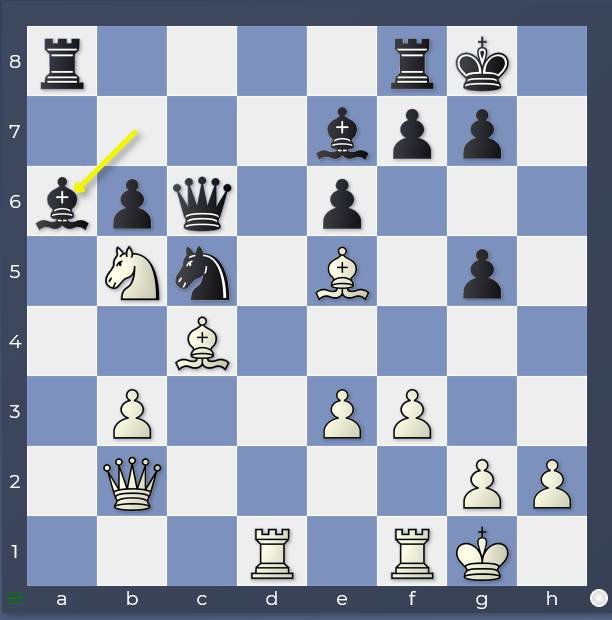
Guimard plays with a lot of ingenuity in this phase, trying hard to drive back the white pieces and avoid weakening his kingside with …f6. However, a tactic is looming….
23.Nd4 Qb7
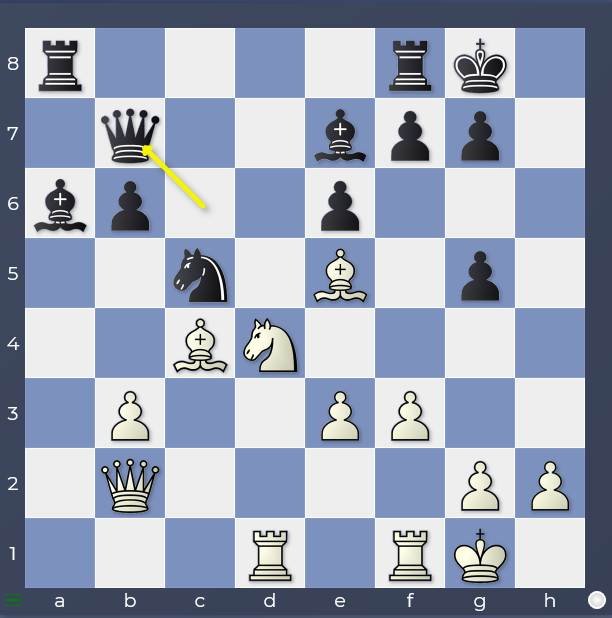
24.Bxa6
24.Bxg7 Stoltz had to make the difficult decision of whether to capture first on a6 before unleashing this shot. The engines prefer the immediate capture to sidestep the counterplay that Black generates in the game. 24…Bxc4 25.Bxf8 (25.bxc4 Na4 26.Qa1 Nc5 saves Black with a draw by repetition!) 25…Bxf1 26.Bxe7 Nd3 27.Qb1 Qxe7 28.Rxf1 Nb4 29.Qe4 with a clear extra pawn for White.
24…Rxa6 25.Bxg7
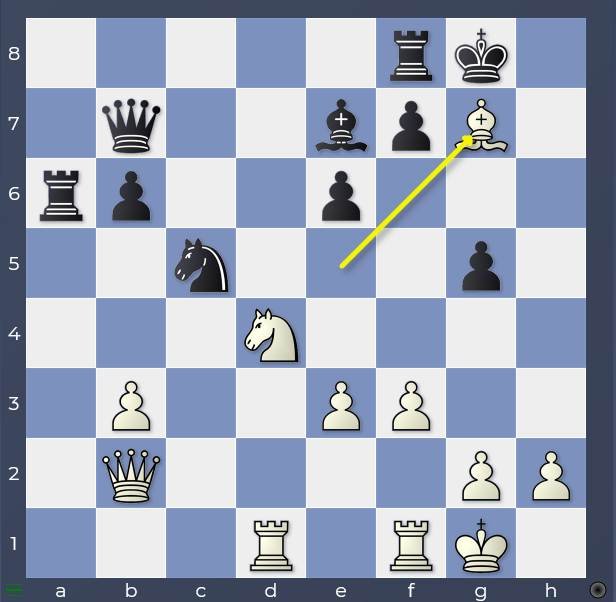
25…Rfa8
25…Kxg7 26.Nf5+ Kg6 27.Qg7+ Kxf5 28.g4# [EB]
26.Be5 Nd7 27.Bg3 Ra2 28.Qb1
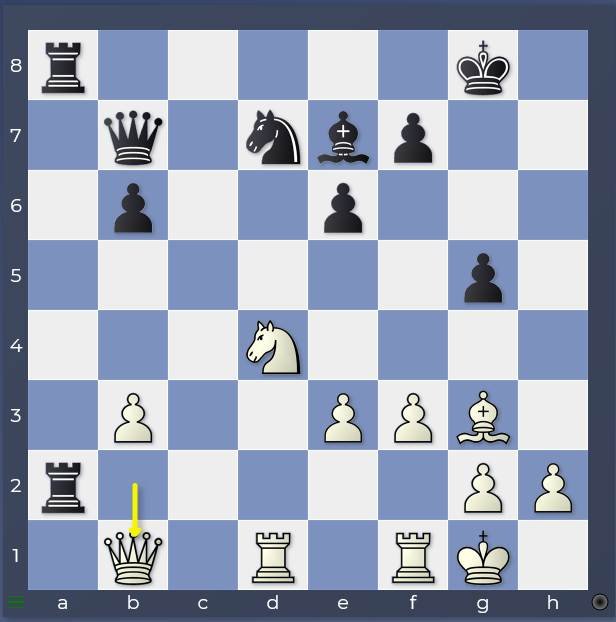
Guimard has played a series of good moves to chase back the white queen and bishop from the a1–h8 diagonal. Unfortunately for Guimard, just at this moment, Stoltz tees up a threat along another channel which Guimard fails to notice!
28…Bf6
So natural to deploy the bishop to control the diagonal which has caused Black so much pain during the game! Yet strangely enough, the additional protection which the bishop seems to provide to the kingside is paper-thin.
[EB] “With a) 28…Nf8 Black could have defended himself better. Now comes a new combination”
This is also reasonable though White’s chances of converting the pawn are better after 29.Rf2 Rxf2 30.Bxf2 Qd5 31.h3;
The brave b) 28…Qd5 is the engine top move when 29.Kh1 Nf6 30.e4 Qc5 31.e5 Ra1
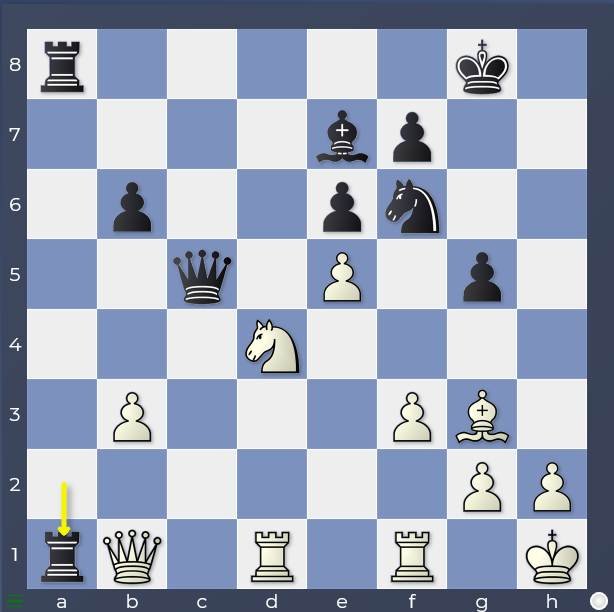
heralds in a wild tactical episode! 32.Nxe6 Rxb1 (32…fxe6 33.Qg6+) 33.Nxc5 Rxd1 34.Rxd1 bxc5 35.exf6 Bxf6 with a clear extra pawn for White but the greatly reduced material and the vulnerable b3–pawn keep White’s advantage to a minimum.
29.Nxe6
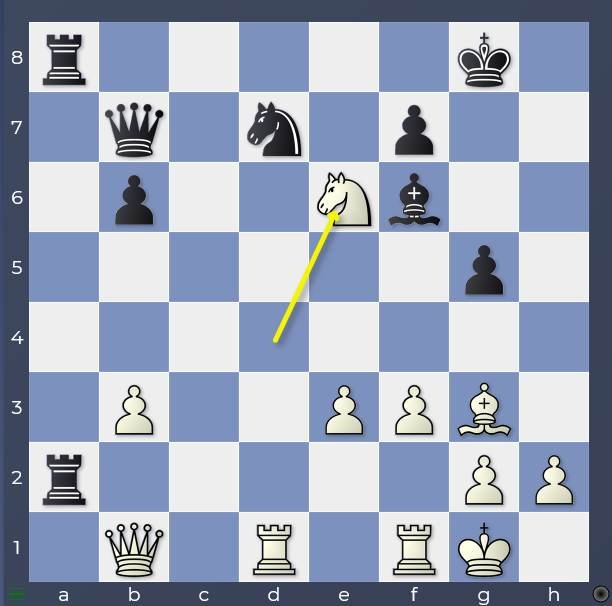
Ouch!
29…fxe6
29…Rb2 30.Qf5 Ra5 31.Rxd7 Rxf5 32.Rxb7 fxe6 33.Rc1 also wins for White
30.Qg6+ Kh8
30…Bg7 31.Qxe6+ is an easy detail to miss!
31.Rxd7 Qxd7 32.Qxf6+ Kh7
32…Qg7 33.Qxe6 with Be5 to follow
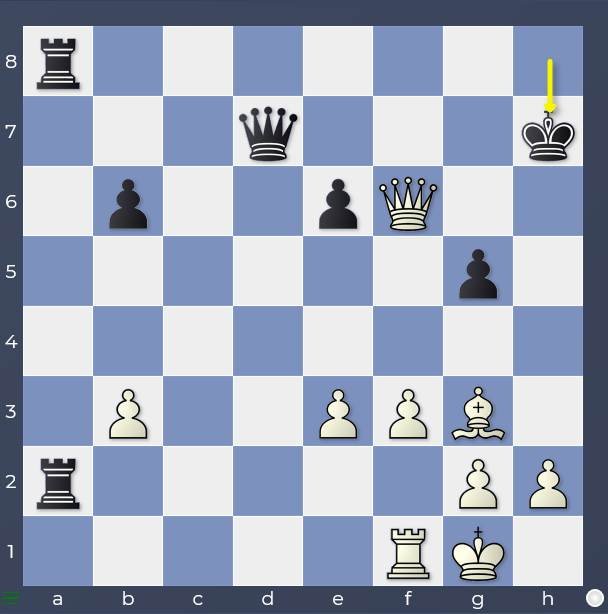
33.Qxg5
33.Be5 was even stronger according to the engines intending the follow-up f4 but the lines are not obvious! 33…Rc8 34.f4 Qb7 35.Bb2
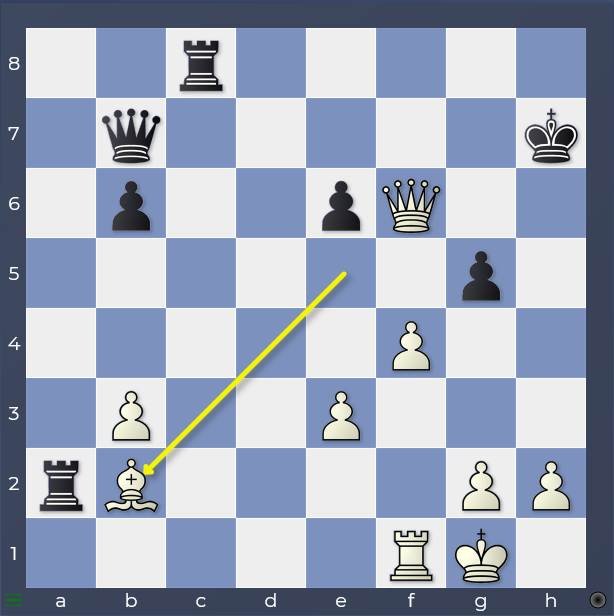
is the subtle point 35…Rc2 36.Qh8+ Kg6 37.Qg8+ Kf5 38.e4+ Kxe4 39.Qxe6+ Kd3 40.Rd1+ Rd2 41.Qc4+ Ke3 42.Re1+ Re2 43.Rxe2# Easy 😉
33…Rd2 34.Qh5+ Kg8 35.Qg6+ Kf8 36.Be1
Really sneaky! The rook can’t move as Bb4+ would come with devastating effect!
36…Raa2 37.Qf6+ Ke8 38.Bxd2 Qxd2 39.Qxe6+ Kd8 40.Qxb6+ Kc8 41.Qc5+ 1–0
The queen protects the kingside from g5… and that’s a lot of pawns!